FPGA-Based Implementation of Digital Signal Processing Algorithms for Real-Time Applications
DOI:
https://doi.org/10.65521/itsi-teee.v8i1.4217Keywords:
Abstract
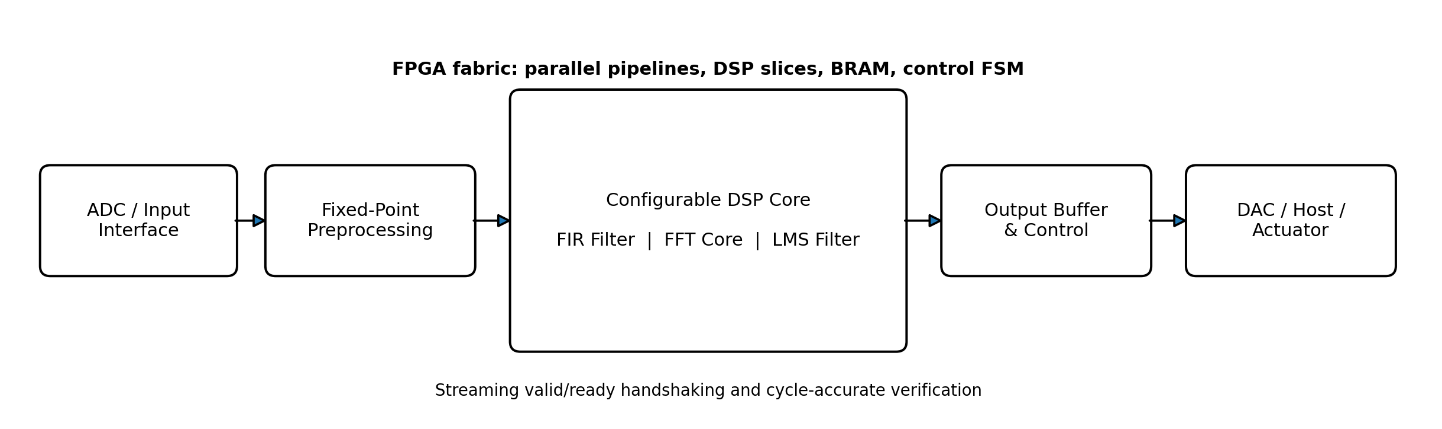
Field-programmable gate arrays (FPGAs) provide a practical platform for real-time digital signal processing (DSP) because arithmetic operations can be spatially parallelized and deeply pipelined while preserving deterministic timing. This methodology paper presents a reproducible design flow for implementing three representative DSP kernels—finite impulse response (FIR) filtering, fast Fourier transform (FFT), and least-mean-square (LMS) adaptive filtering—on an FPGA-oriented streaming architecture. The proposed method begins with floating-point algorithm verification, converts data paths to fixed-point representations, maps multiplication and accumulation to dedicated FPGA resources, introduces pipeline registers to meet timing, and verifies the register-transfer-level behavior against a software reference model. A 32-tap low-pass FIR filter, a 1024-point radix-2 FFT, and a 16-tap LMS filter are used as case studies. Functional fixed-point experiments show an FIR output root-mean-square error of approximately 3.33×10^-5 relative to the floating-point model and about 66 dB suppression of a 12 kHz interferer in the selected test signal. The scaled 1024-point fixed-point FFT preserves the dominant 3 kHz and 7 kHz spectral components with a magnitude RMSE of approximately 1.61×10^-5, while the LMS model reduces the steady-state error power by about 14.5 dB between early and late adaptation windows. The study demonstrates how algorithm–architecture co-design, fixed-point control, pipelining, and cycle-level validation can form a compact workflow for low-latency real-time FPGA DSP systems.