Recent Advances in Early Detection and Segmentation of Diabetic Foot Ulcer Risk Zones Using a Cycle-Consistent Adversarial Adaptation Network from Multimodal Images: A Systematic Review
DOI:
https://doi.org/10.65521/itsi-teee.v14i2.2832Keywords:
Abstract
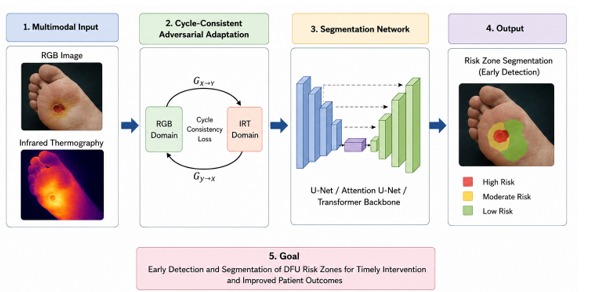
Diabetic Foot Ulcers (DFUs) are serious complications of diabetes that can lead to infection, tissue damage, and lower-limb amputation if not detected early. Recent advances in Artificial Intelligence (AI) and deep learning have significantly improved DFU detection and segmentation accuracy. This review examines recent developments in Cycle-Consistent Adversarial Adaptation Networks (CycleGANs) and multimodal imaging approaches for DFU risk zone analysis. Studies show that Convolutional Neural Networks (CNNs), U-Net models, and transformer-based architectures achieve highly accurate segmentation performance. The integration of RGB and thermal imaging improves early detection by capturing both surface and physiological abnormalities. CycleGAN-based domain adaptation further enhances model performance by enabling feature translation across heterogeneous datasets without requiring paired images, helping overcome data scarcity issues. Hybrid architectures combining adversarial learning, CNNs, and transformers have demonstrated improved robustness, generalization, and diagnostic accuracy. AI-driven DFU systems report detection accuracy ranging from 88% to 97%, outperforming conventional diagnostic methods. Despite these advancements, challenges such as limited annotated datasets, computational complexity, and interpretability remain important concerns for practical clinical deployment.