A Comprehensive Review of Dual-Discriminator Spiking Generative Adversarial Network Based Classification and Segmentation for Predicting Pathogenesis of Foot Ulcers in Patients with Diabetes
DOI:
https://doi.org/10.65521/itsi-teee.v14i2.2859Keywords:
Abstract
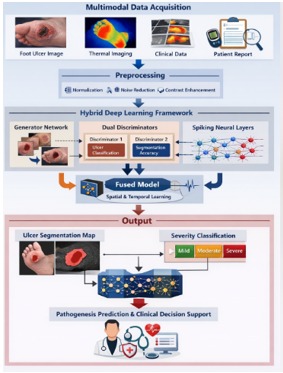
Diabetic foot ulcers (DFUs) represent one of the most severe complications of diabetes mellitus, often leading to infection, amputation, and increased mortality. Early detection and accurate prediction of ulcer pathogenesis are critical for improving patient outcomes. Recent advancements in artificial intelligence have enabled the development of sophisticated models for medical image analysis, particularly in classification and segmentation tasks. Among these, Generative Adversarial Networks (GANs) and Spiking Neural Networks (SNNs) have emerged as powerful paradigms due to their ability to model complex data distributions and mimic biological neural processing, respectively. This paper presents a comprehensive review of dual-discriminator spiking generative adversarial networks (DD-SGANs) for the classification and segmentation of diabetic foot ulcers, focusing on their role in predicting disease progression and pathogenesis. The integration of dual discriminators enhances feature discrimination, while spiking mechanisms improve energy efficiency and temporal feature learning. The review synthesizes existing literature on deep learning, GAN-based medical imaging, and neuromorphic computing applied to DFU analysis. Additionally, it highlights current challenges such as data scarcity, model interpretability, and clinical integration. The paper aims to provide a structured understanding of emerging hybrid architectures and their potential to revolutionize DFU diagnosis and prognosis, paving the way for more accurate, real-time, and clinically applicable solutions.