Thermal and Structural Analysis of Automotive Disc Brakes Using Finite Element Method
DOI:
https://doi.org/10.65521/ijtarme.v5i1.4428Keywords:
Abstract
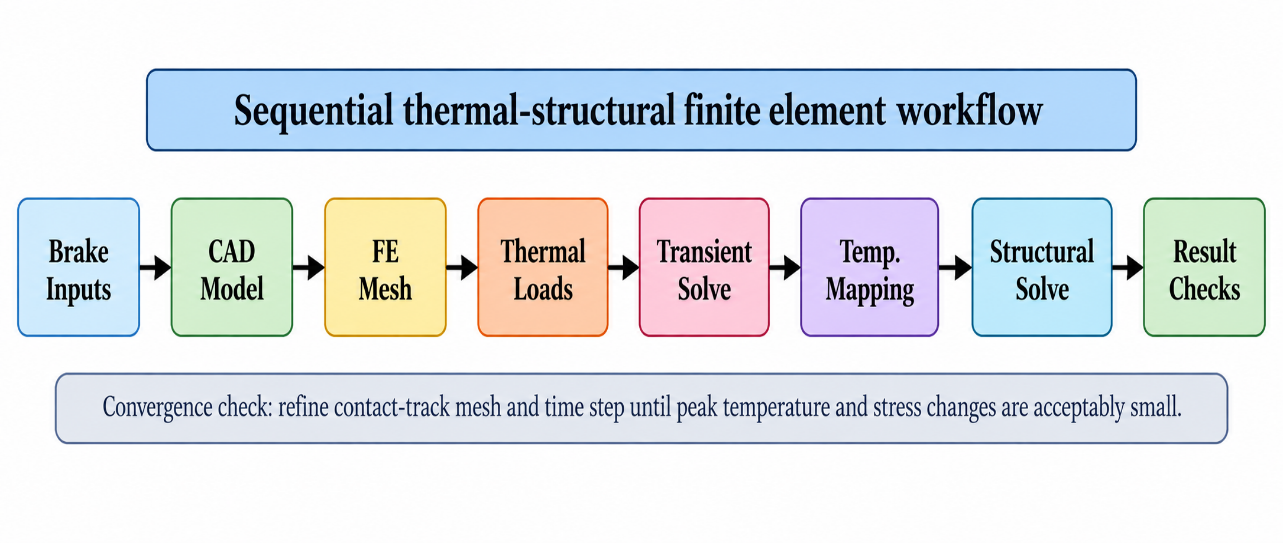
Automotive disc brakes convert a major portion of vehicle kinetic energy into frictional heat within a short braking interval. The resulting non-uniform temperature field produces thermal expansion, rotor coning, local stress concentration and, under severe or repeated braking, conditions favorable to fade, hot spotting and crack initiation. This methodology paper presents a compact finite element procedure for evaluating the coupled thermal and structural response of a ventilated grey-cast-iron brake rotor during a single severe braking event. The procedure begins with calculation of braking energy and interface heat flux, followed by three-dimensional meshing, transient thermal analysis with convection on exposed surfaces, transfer of the nodal temperature field to a structural model, and evaluation of equivalent stress and total deformation. Mesh and time-step convergence are included as mandatory checks. The proposed framework is supported by pre-2017 literature on thermoelastic disc-brake modelling and uses published results as validation benchmarks rather than as replacement experimental data. The expected response is a peak temperature near the swept friction track late in the stop, followed by cooling, while thermal gradients generate the highest structural demand near geometric transitions, ventilation features and constrained hub regions. The method is suitable for comparing rotor geometry, material properties and cooling assumptions before prototype testing.