Design and Performance Evaluation of a Solar-Assisted Refrigeration System for Energy-Efficient Cooling
DOI:
https://doi.org/10.65521/ijtarme.v9i1.4412Keywords:
Abstract
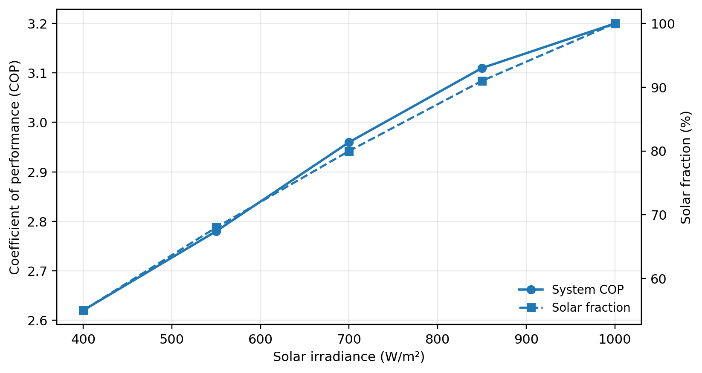
This paper presents the design methodology and performance-evaluation framework for a solar-assisted vapor-compression refrigeration system intended to reduce grid electricity consumption while maintaining reliable cooling under variable solar conditions. The proposed configuration integrates a photovoltaic (PV) array, maximum-power-point-tracking (MPPT) controller, DC bus, variable-speed DC compressor, conventional condenser–expansion–evaporator loop, and grid backup for periods of insufficient solar power. The methodology combines component sizing, thermodynamic analysis, electrical-energy accounting, instrumentation, controlled test conditions, and uncertainty assessment. Performance is evaluated using refrigeration coefficient of performance (COP), solar fraction, PV utilization, cabinet pull-down time, temperature stability, and grid-energy saving. A model-based design evaluation is included to demonstrate the analysis procedure at irradiance levels from 400 to 1000 W/m². The calculated system COP rises from approximately 2.62 to 3.20 as solar availability and compressor matching improve, while the solar fraction increases from 55% to 100%. For an eight-hour representative cooling period, the proposed hybrid arrangement can reduce grid energy use by about 65–70% relative to a grid-only benchmark, depending on weather and load. The methodology is suitable for laboratory prototyping and can be extended to vaccine storage, food preservation, and small commercial cooling applications.