Design and Performance Investigation of Solar Air Heating Systems for Thermal Applications
DOI:
https://doi.org/10.65521/ijtarme.v7i1.4399Keywords:
Abstract
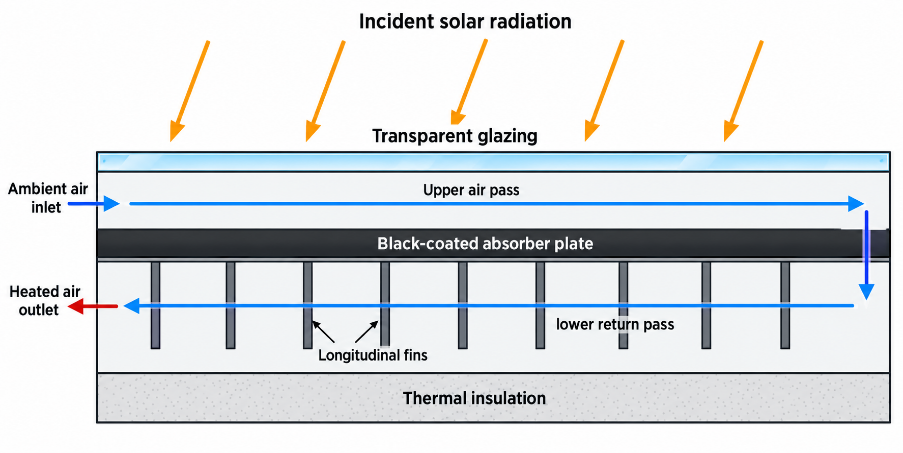
Solar air heating is a low-complexity solar-thermal option for space heating, agricultural drying, preheating and other low-to-medium temperature processes. The present methodology paper develops a compact design and performance-evaluation procedure for a forced-convection double-pass solar air heater using a black-coated aluminum absorber, longitudinal fins and an insulated rectangular duct. The investigation combines design specification, controlled outdoor testing, energy-balance calculations and thermohydraulic assessment. Air mass flow rate is treated as the principal operating variable because it strongly affects outlet temperature, useful heat gain, collector efficiency and pressure drop. Performance is evaluated through the useful heat rate, instantaneous thermal efficiency, Reynolds number and pressure loss. The proposed test matrix covers air flow rates of 0.02–0.05 kg s−1 under near-steady solar irradiance, with temperatures, irradiance and flow measured using calibrated instruments. Earlier studies show that double-pass arrangements, fins and artificial roughness can intensify absorber-to-air heat transfer, although increased friction must be considered in design optimization. The methodology therefore balances heat-transfer enhancement against fan power and flow resistance. Because no raw experimental dataset was supplied for this paper, the Results section contains internally consistent illustrative calculations generated from the stated equations; these values demonstrate the analysis workflow and must not be presented as measured observations. The procedure is suitable for laboratory-scale evaluation and can be extended to solar drying, industrial air preheating and building heating applications.