
ESG Performance and Multidimensional Corporate Risk: A Conceptual Framework and Research Propositions for Indian Firms in the BRSR Era
DOI:
https://doi.org/10.65521/ijrdmr.v15i2.4802Keywords:
Abstract
Purpose: The relationship between environmental, social and governance (ESG) performance and corporate risk is usually studied one risk at a time, which has produced fragmented and often conflicting findings. This paper develops an integrated conceptual framework that explains how ESG performance may affect four dimensions of corporate risk (market, liquidity, operational and legal risk) in Indian listed firms.
Design/methodology/approach: The paper is conceptual. It combines stakeholder theory, the risk-management (insurance) view, signalling theory and legitimacy-institutional theory with published evidence on ESG and firm risk to identify the mechanisms that link ESG to each risk dimension and the factors that condition these links.
Findings: The framework proposes four mechanisms (stakeholder trust and buffering, financing access, management quality, and disclosure and visibility) and derives ten research propositions. ESG is expected to lower market and operational risk, to have an uncertain effect on liquidity, and possibly to increase recorded legal risk under a self-disclosure regime such as the Business Responsibility and Sustainability Report (BRSR). The effects are expected to differ by ESG pillar, sector and firm size.
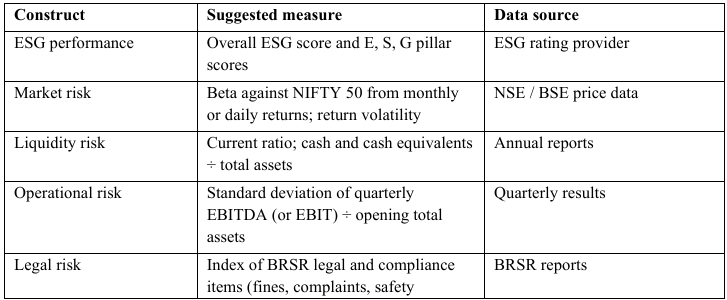
Originality/value: The paper offers a single, testable framework for multidimensional ESG-risk research in India and practical guidance on how to measure each construct using BRSR-era data.
Downloads
Downloads
Published
How to Cite
Issue
Section
License

This work is licensed under a Creative Commons Attribution-NoDerivatives 4.0 International License.