
Artificial Intelligence as a Catalyst for Sustainable Development and Business Transformation: A Conceptual Study
DOI:
https://doi.org/10.65521/ijrdmr.v15i2.4737Keywords:
Abstract
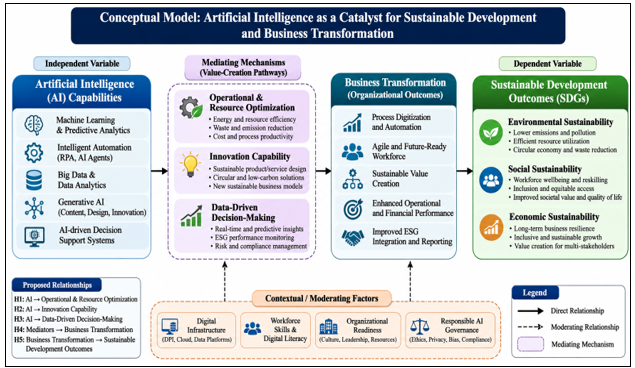
Artificial intelligence (AI) is increasingly positioned at the intersection of business transformation and sustainable development. Its capacity to identify patterns in large datasets, forecast demand and risk, automate routine processes, support product innovation, and improve resource allocation creates opportunities to enhance organizational performance while addressing environmental and social priorities. Yet these outcomes are not automatic: AI can reproduce bias, intensify surveillance, displace or transform work, widen digital inequalities, and consume substantial energy and material resources. This conceptual study synthesizes the supplied literature review on AI-enabled sustainability, digital transformation, innovation, governance, and the Sustainable Development Goals (SDGs). It develops an integrated framework in which AI capabilities influence sustainable business transformation through three complementary mechanisms: operational and resource optimization, innovation capability, and data-driven decision-making. The proposed framework links AI adoption with economic, environmental, and social sustainability through digital infrastructure, workforce skills, organizational readiness, and collaboration. Responsible governance, fairness, accountability, and data protection ensure ethical implementation. AI-driven sustainability requires strategic alignment, organizational learning, and responsible practices to achieve measurable business transformation and sustainable outcomes. As a conceptual paper, it does not claim empirical validation; instead, it offers propositions and a research agenda for future survey, case-study, and structural-equation modelling research.
Downloads
Downloads
Published
How to Cite
Issue
Section
License

This work is licensed under a Creative Commons Attribution-NoDerivatives 4.0 International License.
