
A Comparative Study of the Changes in the Role of Teachers after the New Education Policy-2020, with Reference to the Kota and Bundi Districts of Rajasthan State
DOI:
https://doi.org/10.65521/ijrdmr.v15i2.4719Keywords:
Abstract
Background: India's National Education Policy 2020 (NEP 2020) mandates a systemic shift from didactic instruction to competency-based, learner-centered, and technology-integrated pedagogy. While the policy has been rolled out nationally, district-level empirical evidence on how structural contexts mediate teacher adaptation across urban–rural divides remain critically limited.
Purpose: This study comparatively investigates the structural determinants of NEP 2020 adaptation among secondary and higher-secondary teachers in Kota (urban) and Bundi (rural) districts of Rajasthan, examining how professional capital accumulation varies by context and mediates reform outcomes.
Methods: A concurrent mixed-methods design was employed. Quantitative data were collected from 600 teachers using a validated structured questionnaire grounded in Teacher Professional Capital theory. Qualitative data were gathered through semi-structured interviews with 40 purposively selected teachers. Independent samples t-tests and multiple regression analyses examined district-level differences and predictors of adaptation.
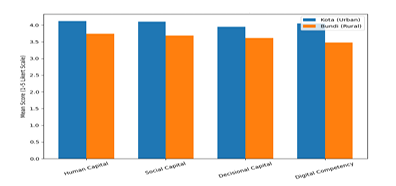
Results: Findings reveal statistically significant urban–rural disparities across all three professional capital dimensions: human, social, and decisional. Infrastructure readiness and digital competency showed the largest effect sizes. Human capital emerged as the strongest predictor of adaptation outcomes; social and decisional capital significantly mediated reform sustainability. The adaptation gap appears structurally determined rather than motivationally driven.
Conclusions: NEP 2020 implementation requires differentiated, district-responsive policy support. Homogenous reform frameworks risk deepening existing structural inequities. Targeted infrastructure investment, decentralized professional development, and collaborative institutional cultures are essential prerequisites for equitable and sustainable reform outcomes.
Downloads
Downloads
Published
How to Cite
Issue
Section
License

This work is licensed under a Creative Commons Attribution-NoDerivatives 4.0 International License.
