
Fostering Healthy Digital Practices: Exploring the Conceptual Relationship between Netiquette and Mental Well-being among Prospective Teachers
DOI:
https://doi.org/10.65521/ijrdmr.v15i2.4693Keywords:
Abstract
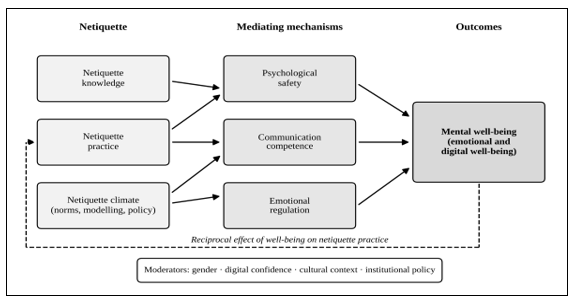
Digital communication now sits at the centre of how prospective teachers learn, collaborate and prepare for the profession, yet the courtesy norms that govern those exchanges, commonly called netiquette, are seldom examined as a matter of psychological health. This conceptual paper examines how netiquette and mental well-being may be related among prospective teachers. It draws on a synthesis of seventeen sources on netiquette, digital citizenship, cyber incivility, digital well-being and teacher education. The paper first clarifies the key constructs and then reviews what is known about how online conduct shapes emotional experience in educational settings. The synthesis shows that the evidence connecting the two domains is indirect and unevenly distributed: studies of netiquette rarely measure well-being, and studies of well-being rarely isolate netiquette. To bridge this gap, the paper proposes a conceptual model in which netiquette knowledge, netiquette practice and the netiquette climate of a learning community influence well-being through psychological safety, communication competence and emotional regulation, with gender, digital confidence, cultural context and institutional policy as possible moderators. Five testable propositions and a research agenda follow, together with implications for teacher education programmes, including those operating under India's National Education Policy 2020. The paper argues that netiquette education should be reframed from an exercise in rule compliance into a well-being-oriented competence for future teachers.
Downloads
Downloads
Published
How to Cite
Issue
Section
License

This work is licensed under a Creative Commons Attribution-NoDerivatives 4.0 International License.
