Hybrid Work: The Long-Term Impact of Flexible Working Models on Organizational Culture and Overall Employee Productivity
DOI:
https://doi.org/10.65521/ijrdmr.v15i2.4669Keywords:
Abstract
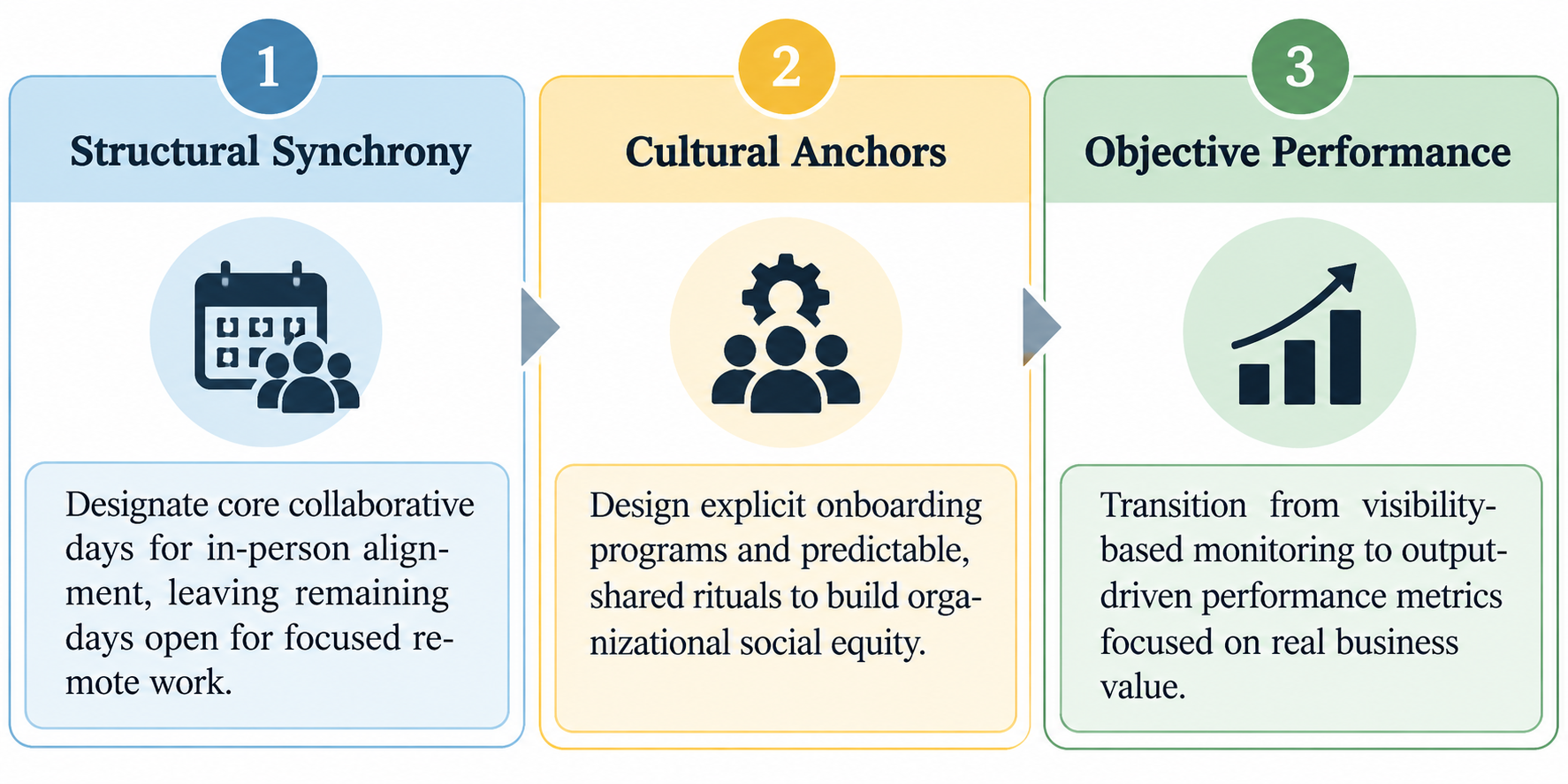
The seismic shift from traditional co-located office environments to hybrid working frameworks has emerged as the defining structural transformation of the mid-2020s cor-porate landscape. This study presents a comprehensive, multi-methodological empirical investigation into the long-term impacts of hybrid work models on organizational cul-ture and overall employee productivity. Relying on the structural scaffolding of the Job Demands-Resources (JD-R) model and Nonaka’s “Ba” framework, we evaluate how spatial and temporal flexibility modulate workplace dynamics, psychological safety, and knowl-edge externalization. Using empirical cross-sectional survey data from N = 420 corpo-rate knowledge workers across technology, finance, and professional services, comple-mented by structured qualitative focus groups, we demonstrate that intermediate hybrid structures (2 to 3 days remote per week) maximize individual productivity, job satisfac-tion, and work-life balance compared to extreme full-remote or rigid full-office arrange-ments. However, the study identifies a significant long-term decay in organic organiza-tional culture, social capital formulation, and continuous inter-departmental collaboration, accompanied by heightened risks of proximity bias and fragmented psychological safety. Based on these findings, we formulate actionable corporate strategy frameworks for HR executives, proposing dynamic cultural anchors, intentional synchronous scheduling, and artifact-driven socialization to sustain high productivity without eroding the underlying socio-cultural tissue of the firm.
Downloads
Downloads
Published
How to Cite
Issue
Section
License

This work is licensed under a Creative Commons Attribution-NoDerivatives 4.0 International License.
