
From Corporate Responsibility to Strategic Sustainability: Investigating ESG Integration, Stakeholder Trust, and Long-Term Organizational Performance
DOI:
https://doi.org/10.65521/ijrdmr.v9i1.4277Keywords:
Abstract
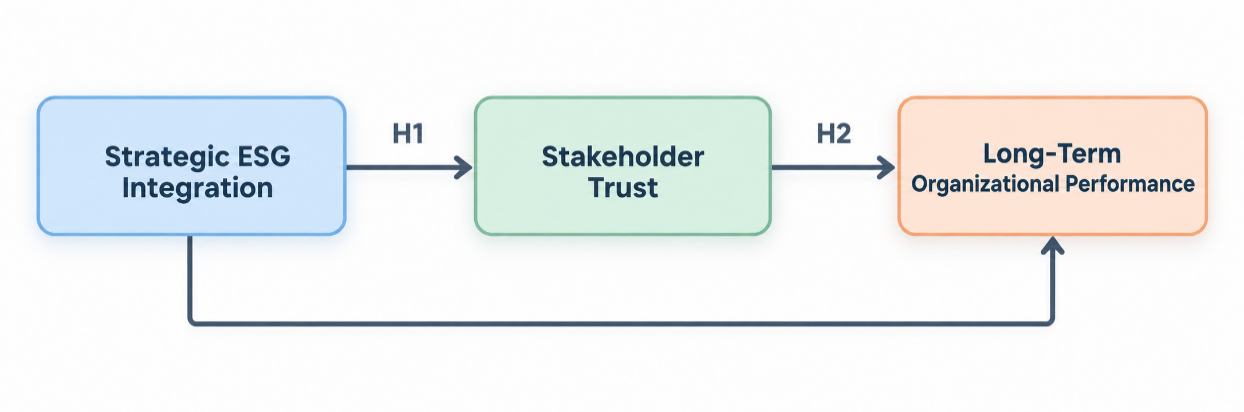
This methodology-oriented paper develops an integrated research framework for examining the transition from conventional corporate responsibility to strategic sustainability through the combined effects of environmental, social, and governance (ESG) integration, stakeholder trust, and long-term organizational performance. The study is grounded in stakeholder theory, the resource-based view, signaling logic, and the business-case literature on corporate social responsibility (CSR). Prior research shows that sustainability can become embedded in organizational processes and can influence performance when firms treat environmental and social concerns as strategic rather than peripheral activities (Eccles, Ioannou, & Serafeim, 2014; Friede, Busch, & Bassen, 2015). The proposed methodology adopts a quantitative, explanatory, cross-sectional design supported by an integrative review of studies published up to 2020. Strategic ESG integration is conceptualized as the degree to which environmental, social, and governance considerations are incorporated into governance, risk management, resource allocation, stakeholder engagement, and performance measurement. Stakeholder trust is modeled as a mediating mechanism, while long-term organizational performance is represented through financial resilience, market value, operational capability, reputation, innovation, and adaptive capacity. The proposed empirical model can be tested using partial least squares structural equation modeling (PLS-SEM) or covariance-based SEM, depending on data characteristics. The paper contributes a structured construct-operationalization scheme, a testable hypothesis system, and an analytical protocol designed to distinguish symbolic responsibility from strategically material sustainability. Because no primary dataset is supplied, the Results section presents literature-derived expected relationships rather than fabricated empirical coefficients. The framework is intended for future organizational surveys and multi-source ESG studies in which strategic integration, stakeholder trust, and performance outcomes can be examined simultaneously.
Downloads
Downloads
Published
How to Cite
Issue
Section
License

This work is licensed under a Creative Commons Attribution-NoDerivatives 4.0 International License.
