
Advancing Financial Inclusion Through Emerging Digital Technologies: A Conceptual Study
DOI:
https://doi.org/10.65521/ijrdmr.v15i2.3835Keywords:
Abstract
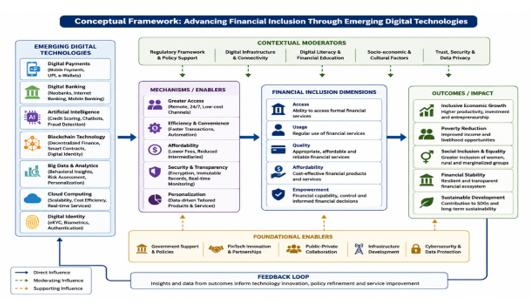
Financial inclusion has become a critical driver of sustainable economic development by enabling individuals and businesses to access affordable, secure, and efficient financial services. The rapid advancement of emerging digital technologies has significantly transformed the financial services landscape, creating new opportunities to overcome traditional barriers such as geographical isolation, high transaction costs, inadequate financial infrastructure, and limited access to formal banking systems. This conceptual study examines how emerging digital technologies advance financial inclusion through a synthesis of recent literature published between 2023 and 2026. It explores the roles of FinTech, digital payments, digital banking, artificial intelligence, blockchain, big data analytics, cloud computing, and digital identity systems in improving financial accessibility, efficiency, transparency, affordability, and customer empowerment. A conceptual framework is proposed linking these technologies to five dimensions of financial inclusion: access, usage, quality, affordability, and financial empowerment. The study emphasizes that effective implementation requires supportive regulations, robust digital infrastructure, financial literacy, cybersecurity, digital trust, and public–private collaboration. Although emerging digital technologies present enormous opportunities for inclusive growth, several challenges such as digital inequality, cybersecurity risks, data privacy concerns, regulatory uncertainty, and inadequate digital capabilities continue to hinder widespread adoption. The study concludes that an integrated digital financial ecosystem supported by technological innovation and sound governance can significantly accelerate financial inclusion while contributing to poverty reduction, social inclusion, economic resilience, and the achievement of the Sustainable Development Goals (SDGs). The findings provide valuable insights for policymakers, financial institutions, researchers, and technology providers seeking to design sustainable and inclusive digital financial systems.
Downloads
Downloads
Published
How to Cite
Issue
Section
License

This work is licensed under a Creative Commons Attribution-NoDerivatives 4.0 International License.
