
Artificial Intelligence-Driven Integrated Supply Chain, Merchandising, And Inventory Management Framework for Enhancing Omnichannel Retail Performance
DOI:
https://doi.org/10.65521/ijrdmr.v14i2.3813Keywords:
Abstract
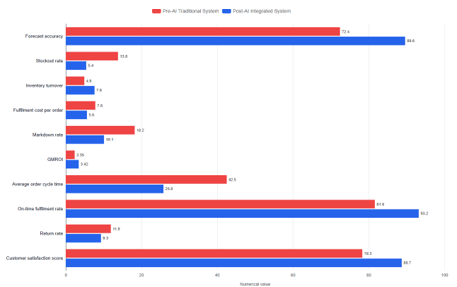
Omnichannel retailing has revolutionized the way retail businesses operate in today's digital era, bringing together physical stores, online platforms, mobile apps, social media channels, marketplaces, and last-mile delivery systems into a seamless and customer-centric experience. The growth of omnichannel retailing has increased the complexity of supply chain, merchandising, and inventory management. Retailers must optimize product availability, inventory levels, pricing, and customer experience across multiple sales channels. Artificial intelligence addresses these challenges through predictive analytics, machine learning, demand forecasting, automated replenishment, dynamic assortment planning, and intelligent decision support. This paper presents a conceptual AI-based framework integrating supply chain, merchandising, and inventory management to enhance operational efficiency, inventory optimization, and customer satisfaction in omnichannel retail environments. It presents an integrated view that includes data collection, demand planning, inventory transparency, assortment planning, replenishment automation, fulfilment orchestration and performance monitoring. The quantitative simulation-based results section uses hypothetical but realistic data to illustrate how the application of AI can impact key retail performance metrics such as forecast accuracy, inventory turnover, stock out rates, fulfilment cost, markdown rates, gross margin return on inventory investment, order cycle time, and customer satisfaction. The results indicate that using an integrated artificial intelligence framework can boost the forecast accuracy rate by 17.2% and the stockout rate by 8.4%, achieve a 30% increase in inventory turnover (from 4.9 to 7.6 times per year), lower the markdown rate by 8.1% (from 18.2% to 10.1%) and increase customer satisfaction from the omnichannel perspective by 8.4 points (from 78.3 to 88.7). The paper concludes that the combination of artificial intelligence-powered integration, coupled with quality data governance, cross-functional coordination, scalable technology infrastructure and ethical decision controls can help boost retail agility, operational responsiveness, merchandising precision and inventory productivity.
Downloads
Downloads
Published
How to Cite
Issue
Section
License

This work is licensed under a Creative Commons Attribution-NoDerivatives 4.0 International License.
