
Transforming Student Education Through Digital Teaching Platforms: A Conceptual Perspective
DOI:
https://doi.org/10.65521/ijrdmr.v15i2.3688Keywords:
Abstract
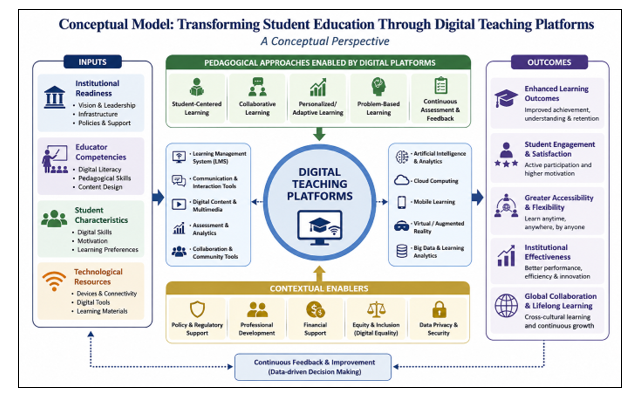
The rapid advancement of digital technologies has transformed the educational landscape by shifting traditional classroom instruction toward technology-enabled, learner-centered education. Digital teaching platforms have emerged as strategic educational tools that facilitate flexible learning, personalized instruction, collaborative engagement, and continuous assessment. This conceptual paper examines the transformative role of digital teaching platforms in enhancing student education by synthesizing recent scholarly literature on digital pedagogy, educational technology, and digital transformation in higher education. The study reviews conceptual and empirical literature to identify key dimensions of digital teaching platforms, including accessibility, pedagogical innovation, personalized learning, competency-based education, collaborative knowledge creation, and technology-enabled assessment. It proposes an integrated conceptual model demonstrating how institutional readiness, educator competencies, technological resources, and student characteristics influence successful implementation, while highlighting the contributions of LMS, artificial intelligence, cloud computing, learning analytics, and virtual learning environments, alongside challenges such as digital inequality, infrastructure limitations, cybersecurity concerns, and resistance to pedagogical change.The findings suggest that the successful transformation of education requires more than technological adoption; it demands a holistic integration of technology, pedagogy, institutional support, and policy interventions. Furthermore, digital teaching platforms are shown to foster higher-order thinking, learner autonomy, collaborative learning, and evidence-based educational decision-making through continuous assessment and learning analytics. The paper contributes to the growing body of knowledge by providing a comprehensive conceptual perspective that integrates technological, pedagogical, and institutional dimensions of digital education within a unified framework. The proposed model offers valuable theoretical insights for researchers while providing practical guidance for educators, institutional leaders, and policymakers seeking to design sustainable, inclusive, and student-centered digital learning ecosystems capable of meeting the evolving demands of twenty-first-century education.
Downloads
Downloads
Published
How to Cite
Issue
Section
License

This work is licensed under a Creative Commons Attribution-NoDerivatives 4.0 International License.
