
Digital Learning Platforms and Student Engagement: A Conceptual Study in Higher Education
DOI:
https://doi.org/10.65521/ijrdmr.v15i2.3687Keywords:
Abstract
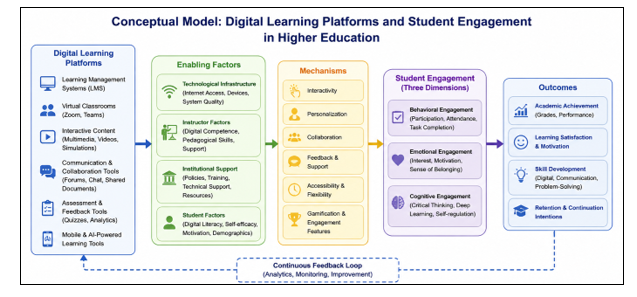
The rapid advancement of digital technologies has transformed higher education by introducing innovative digital learning platforms that support flexible, interactive, and student-centered learning. Platforms such as Learning Management Systems (LMS), virtual classrooms, mobile learning applications, artificial intelligence (AI), and learning analytics have become essential components of contemporary educational practices. While previous studies have extensively examined the effectiveness of individual digital technologies, there remains a need for a comprehensive conceptual understanding of how multiple technological, pedagogical, institutional, and learner-related factors collectively influence student engagement. This conceptual study synthesizes recent scholarly literature to develop an integrated framework explaining the relationship between digital learning platforms and student engagement in higher education. The proposed framework identifies four major enabling factors technological infrastructure and accessibility, pedagogical integration and instructor role, student characteristics and engagement, and motivation and psychosocial factors that collectively influence behavioural, emotional, and cognitive engagement. The framework further illustrates how enhanced student engagement contributes to improved academic achievement, learning satisfaction, skill development, and student retention through continuous feedback mechanisms supported by learning analytics. The review highlights that the successful implementation of digital learning platforms depends not only on technological availability but also on effective pedagogy, institutional readiness, digital literacy, instructor competence, and learner motivation. Despite significant progress in digital education, challenges such as the digital divide, inadequate infrastructure, privacy concerns, faculty preparedness, and unequal technological access continue to limit educational effectiveness. The study contributes to the existing literature by integrating fragmented research into a comprehensive conceptual model that may guide future empirical investigations and support policymakers, institutional leaders, and educators in designing inclusive, engaging, and sustainable digital learning environments.
Downloads
Downloads
Published
How to Cite
Issue
Section
License

This work is licensed under a Creative Commons Attribution-NoDerivatives 4.0 International License.
