Performance-Based Design of Steel Moment Resisting Frames Using Alternate Path Method (APM) For Progressive Collapse Mitigation
Article Sidebar
Main Article Content
Abstract
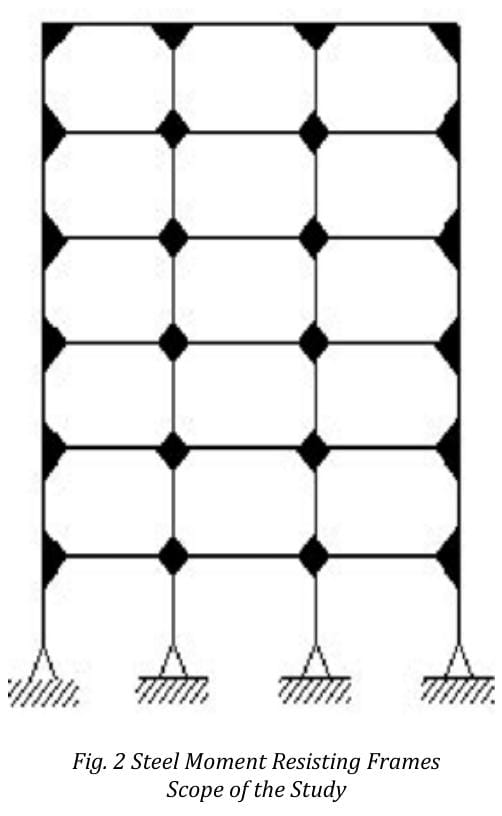
Progressive collapse is a catastrophic structural failure that occurs when the loss of one or more critical load-bearing elements leads to disproportionate damage or total collapse of a structure. To enhance structural robustness and safety, performance-based design approaches have been increasingly adopted. This study focuses on the performance-based design of steel moment-resisting frames (SMRFs) using the Alternate Path Method (APM) to evaluate and mitigate the risk of progressive collapse. The research involves modeling steel frame structures subjected to sudden column removal scenarios to simulate accidental load cases as per guidelines from GSA (2016) and DoD (2013). Nonlinear static and dynamic analyses are conducted to assess load redistribution, deformation capacity, and energy absorption mechanisms within the frame. The results are evaluated based on performance criteria such as ductility demand, plastic hinge formation, and residual strength. The findings are expected to contribute to developing practical design recommendations for improving the robustness and resilience of steel moment-resisting frames under accidental loading conditions.
Progressive collapse is a catastrophic structural failure that occurs when the loss of one or more critical load-bearing elements leads to disproportionate damage or total collapse of a structure. To enhance structural robustness and safety, performance-based design approaches have been increasingly adopted. This study focuses on the performance-based design of steel moment-resisting frames (SMRFs) using the Alternate Path Method (APM) to evaluate and mitigate the risk of progressive collapse. The research involves modeling steel frame structures subjected to sudden column removal scenarios to simulate accidental load cases as per guidelines from GSA (2016) and DoD (2013). Nonlinear static and dynamic analyses are conducted to assess load redistribution, deformation capacity, and energy absorption mechanisms within the frame. The results are evaluated based on performance criteria such as ductility demand, plastic hinge formation, and residual strength. The findings are expected to contribute to developing practical design recommendations for improving the robustness and resilience of steel moment-resisting frames under accidental loading conditions.
Downloads
Article Details

This work is licensed under a Creative Commons Attribution-NoDerivatives 4.0 International License.