
Resource-Aware Workload Distribution and Performance Analysis in Heterogeneous Cloud Systems
DOI:
https://doi.org/10.65521/intjournalrecadvengtech.v5i1.4392Keywords:
Abstract
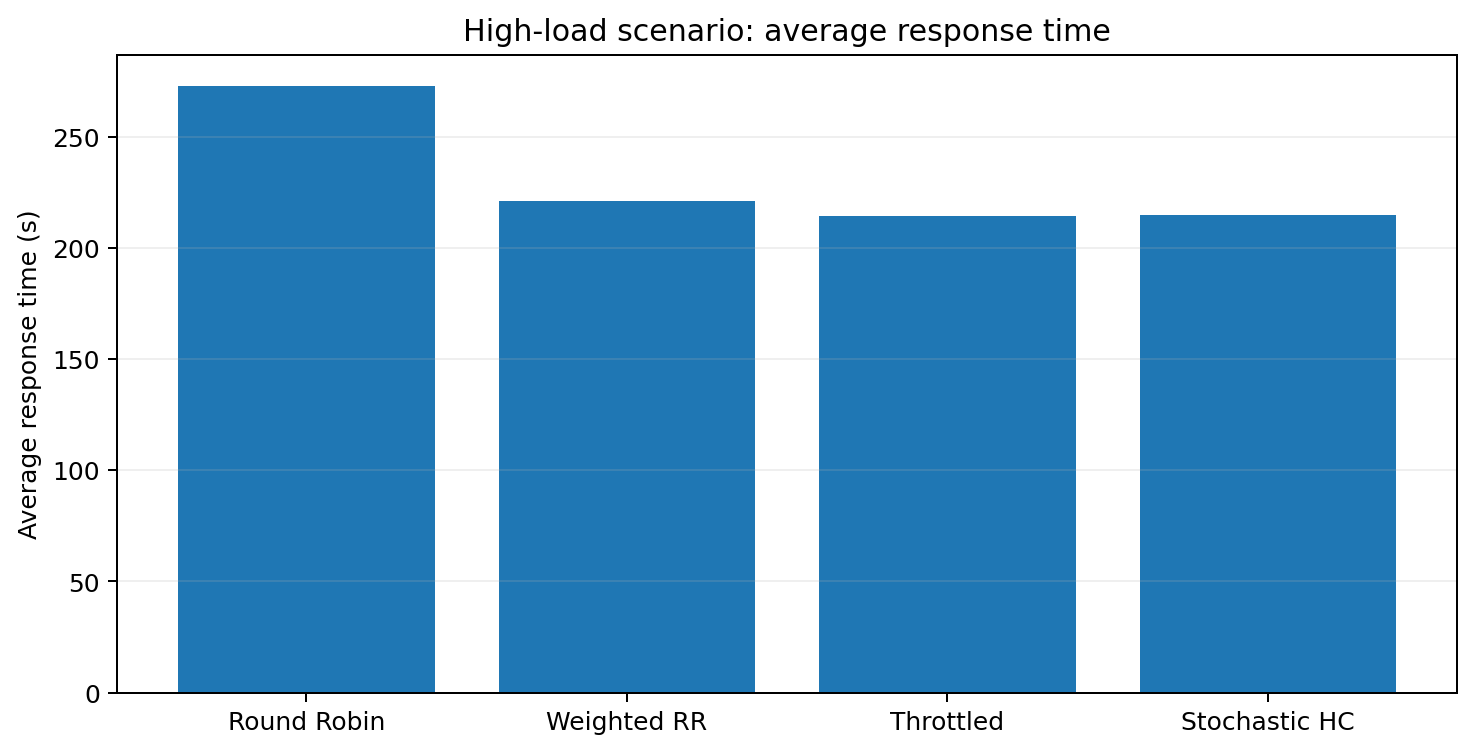
Efficient workload distribution is essential for maintaining responsive and balanced operation in heterogeneous cloud computing systems where virtual machines differ in processing capacity and incoming computational demand changes over time. This study presents a controlled performance analysis of four representative workload-allocation strategies: Round Robin, Weighted Round Robin, a throttled least-finish-time approach, and Stochastic Hill Climbing. An event-driven simulation environment is constructed using 20 heterogeneous virtual machines with processing capacities ranging from 800 to 4200 MIPS. Computational tasks with variable lengths are generated under low, medium, and high workload intensities, while identical workload streams and infrastructure settings are maintained across all strategies to ensure fair comparison. Performance is evaluated using average response time, makespan, throughput, resource utilization, and degree of imbalance. The results demonstrate that simple cyclic allocation becomes increasingly inefficient as workload intensity and resource heterogeneity increase. Weighted Round Robin improves allocation by considering virtual-machine capability but remains limited by its dependence on predefined weights. In contrast, the throttled and Stochastic Hill Climbing approaches use current resource-state information to achieve substantially better workload distribution under heavy demand. In the 1,200-task scenario, both approaches achieve approximately 2.69 tasks per second throughput and around 97% resource utilization, while maintaining a degree of imbalance close to 0.05. Round Robin records significantly lower utilization and higher imbalance under the same conditions. The findings indicate that resource-aware and state-responsive scheduling strategies are more suitable for heterogeneous and time-varying cloud environments, while static approaches remain useful where simplicity and low scheduling overhead are primary requirements.
Downloads
Downloads
Published
How to Cite
Issue
Section
License

This work is licensed under a Creative Commons Attribution-NoDerivatives 4.0 International License.
