
Artificial Intelligence Techniques for Multi-classification of Brain Tumor MRI Images Using Deep Dynamic Parallel Convolutional Neural Network with Fully Termite Alate Optimization Algorithm: Trends and Challenges
DOI:
https://doi.org/10.65521/intjournalrecadvengtech.v14i1.2568Keywords:
Abstract
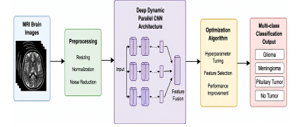
Brain tumour classification using Magnetic Resonance Imaging (MRI) has become a critical research area due to the need for accurate, early, and automated diagnosis. Traditional manual diagnosis is time-consuming and prone to variability, motivating the adoption of Artificial Intelligence (AI) and deep learning approaches. In recent years, convolutional neural networks (CNNs) and hybrid optimization techniques have significantly improved classification accuracy. This paper presents a comprehensive review of AI-based multi-classification techniques, focusing on deep dynamic parallel convolutional neural networks integrated with optimization algorithms such as Termite Alate Optimization. The study explores recent advancements in deep learning architectures, including parallel CNN models, transfer learning frameworks, and hybrid optimization strategies that enhance feature extraction and classification performance. Parallel CNN architectures are particularly effective in capturing both global and local features simultaneously, improving classification robustness. Furthermore, optimization algorithms play a vital role in tuning hyperparameters and improving convergence efficiency. The integration of metaheuristic algorithms with deep learning has shown promising results in reducing computational complexity while enhancing model accuracy. This review highlights trends, challenges, and future research directions, emphasizing the need for scalable, interpretable, and clinically reliable AI systems for brain tumour diagnosis.
Downloads
Downloads
Published
How to Cite
Issue
Section
License

This work is licensed under a Creative Commons Attribution-NoDerivatives 4.0 International License.
