
Artificial Intelligence Techniques for Efficient Energy Management in IoT-Enabled Large Buildings: Giant Trevally Optimizer (GTO) based Electric Vehicle Scheduling, Distributed Resource Integration, and Demand Response Strategies: Trends and Challenges
DOI:
https://doi.org/10.65521/intjournalrecadvengtech.v14i1.2562Keywords:
Abstract
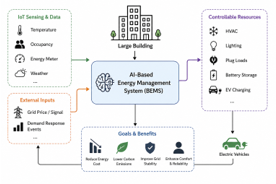
The rapid proliferation of Internet of Things (IoT) technologies has transformed energy management in large buildings, enabling real-time monitoring, automation, and data-driven optimization. As buildings account for a significant share of global energy consumption, the integration of electric vehicles, distributed energy resources, and smart grid interactions introduces complex challenges requiring intelligent and adaptive management solutions. This paper presents a comprehensive review of artificial intelligence-driven energy management frameworks, with a focus on the Giant Trevally Optimizer (GTO). As a bio-inspired metaheuristic algorithm, GTO effectively addresses multi-objective optimization problems in building energy systems, including cost minimization, peak load reduction, and renewable energy utilization. The review also examines the integration of deep learning techniques, IoT-based sensing, and predictive models to enhance decision-making in electric vehicle scheduling, demand response strategies, and distributed energy resource coordination.
Applications include smart charging of electric vehicles, microgrid optimization, and intelligent load management in IoT-enabled buildings. Comparative analysis demonstrates that GTO-based and hybrid AI approaches outperform traditional optimization techniques in scalability, convergence speed, and efficiency. However, challenges such as interoperability, cybersecurity, and real-time deployment remain. This review highlights the potential of combining IoT, AI, and advanced optimization methods to develop sustainable, scalable, and intelligent energy management systems for future smart cities.
Downloads
Downloads
Published
How to Cite
Issue
Section
License

This work is licensed under a Creative Commons Attribution-NoDerivatives 4.0 International License.
