Bridging Ancient Ayurveda with Modern Sensor Technology: Comprehensive Review
DOI:
https://doi.org/10.65521/intjournalrecadvengtech.v14i3s.1678Keywords:
Abstract
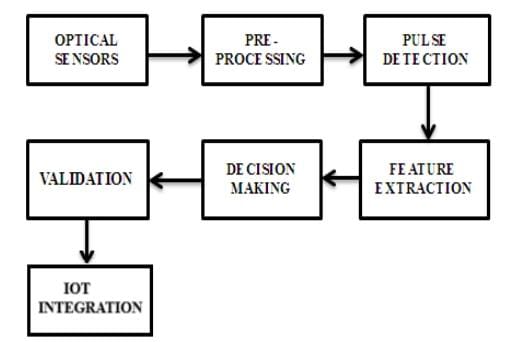
Nadi Pariksha, an ancient Ayurvedic method of diagnosis, evaluates the balance of the three Doshas—Vata, Pitta, and Kapha—by analyzing the pulse at the radial artery. This technique, traditionally practiced by experienced professionals, provides important information about a person’s health condition but relies on personal interpretation and extensive training. This paper introduces an IoT-based system for Nadi Pariksha that converts pulse examination into a digital process to enable more objective health tracking and early disease detection. The system uses a three-sensor setup placed at the Cun, Guan, and Chi points on the wrist to measure pulse waveforms associated with each Dosha. These signals undergo filtering and cleaning before being analyzed to identify time, frequency, and shape-based features. Machine learning algorithms then use these features to determine the balance of the three Doshas and spot irregularities that may signal cardiovascular or metabolic problems. The data is sent securely through IoT methods to a cloud platform, where it can be viewed and reviewed in real time. This approach combines traditional knowledge with current technology, allowing for non-invasive, inexpensive, and ongoing health monitoring. This can significantly improve access to preventive healthcare, especially in areas with limited resources.
Downloads
Downloads
Published
How to Cite
Issue
Section
License

This work is licensed under a Creative Commons Attribution-NoDerivatives 4.0 International License.
