Development of a Line Following Robot Using Embedded Control Systems
Keywords:
Abstract
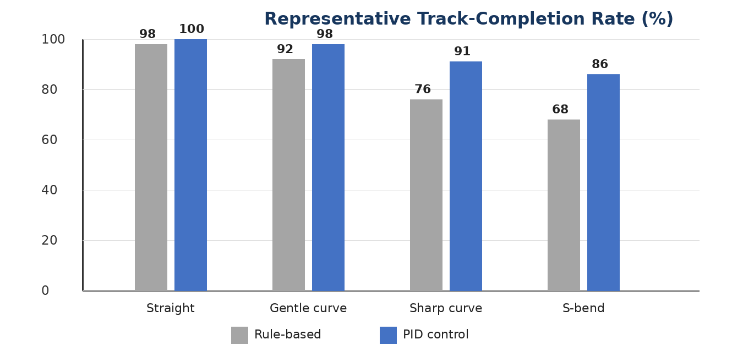
This paper presents a reproducible methodology for developing a low-cost line-following robot around an embedded microcontroller, an infrared reflectance-sensor array, a dual H-bridge driver, and a differential-drive chassis. The work emphasizes the complete engineering chain: requirement definition, optical calibration, weighted line-position estimation, closed-loop steering, firmware timing, prototype integration, and structured validation. A discrete proportional-integral-derivative (PID) controller converts the lateral line error into complementary pulse-width-modulated wheel commands. The proposed test plan evaluates straight-path accuracy, curve negotiation, recovery after temporary line loss, completion rate, settling time, and energy use. A representative design-validation dataset shows that PID control improves completion on sharp curves and S-bends compared with a threshold rule-based controller, while retaining a simple 8-bit embedded implementation. The paper also identifies lighting sensitivity, wheel mismatch, battery-voltage variation, and derivative noise as principal limitations. The resulting framework is suitable for teaching laboratories and as a foundation for automated guided vehicles, provided that safety, payload, localization, and industrial reliability requirements are addressed separately.