A Bench Demonstrator for Inductive Roadway Power Transfer And 433 MHz In-Cabin Road-Signal Display
Keywords:
Abstract
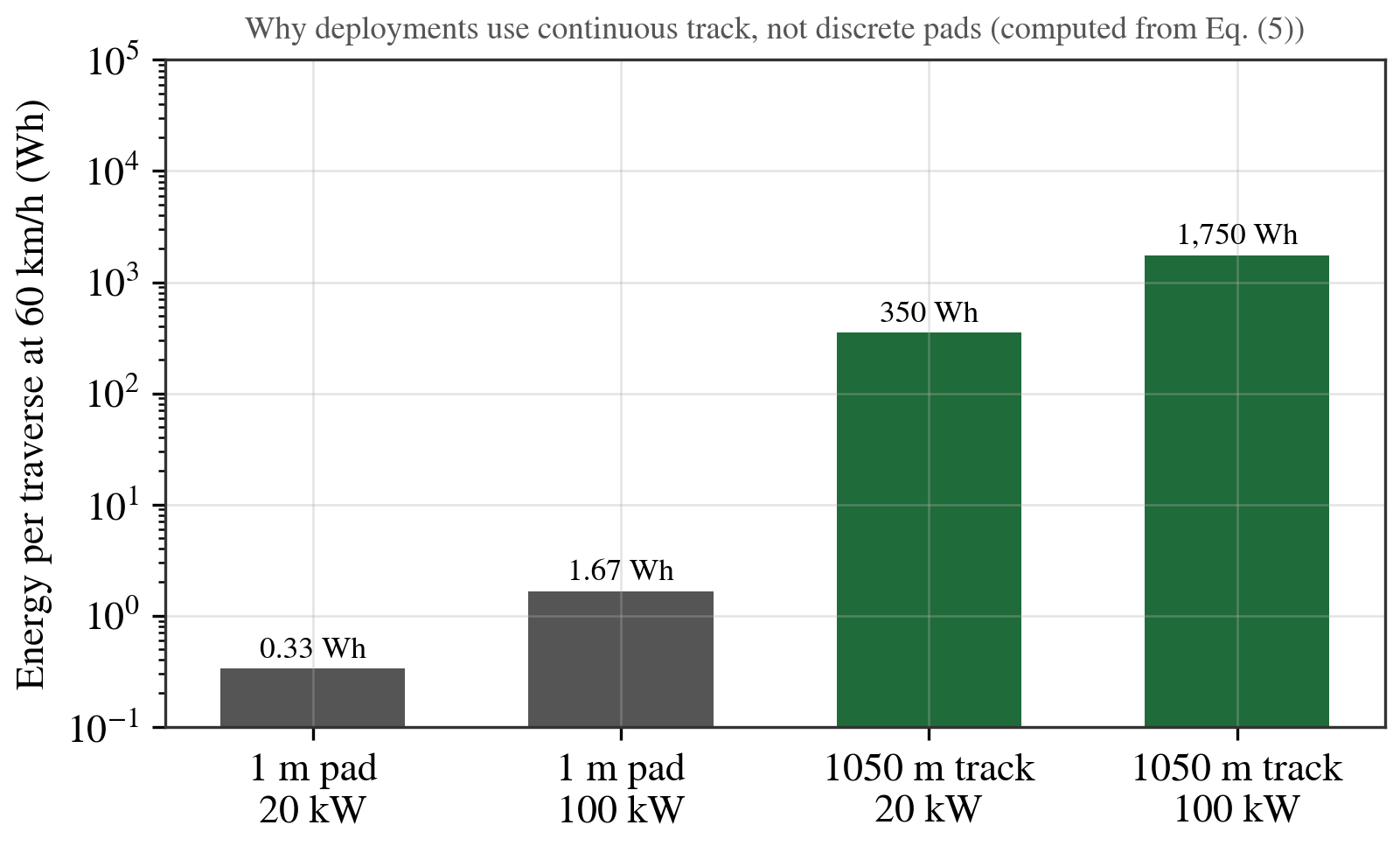
This paper reports a bench demonstrator that combines two functions proposed for future road infrastructure: inductive power transfer to a moving vehicle from a renewably supplied roadway coil, and in-cabin display of road-signal information carried over a 433 MHz radio link. The demonstrator was built around an Arduino controller, a 433 MHz transmitter and receiver pair, a relay stage, coupled coils, a bridge rectifier, a DC-DC chopper, a linear regulator, a lead-acid battery and a 12 V 10 W photovoltaic panel. Its signalling function was shown to operate end to end. Its power-transfer chain was assembled and energised but never characterised, and the paper states this rather than substituting figures drawn from the literature. The principal contribution is therefore a disciplined separation of what this hardware measured from what the project record merely reproduced. The comparison table in that record, listing air gaps of 102 and 125 mm, operating frequencies of 20 and 22-23 kHz, link powers of 3.3 and 20 kW and efficiencies of 90 %, is reclassified here as reference data. The reclassification is arithmetic rather than cautionary: the quoted 20 kW exceeds the prototype's source rating by a factor of two thousand, and the panel's whole daily yield of roughly 50 Wh would sustain a 20 kW link for about nine seconds. No link efficiency, coupling coefficient, transferred power or air-gap tolerance is claimed for the built hardware, because none was measured. The paper consolidates the coupling, quality-factor, efficiency and dwell-time relations that govern dynamic charging; adds a table of independently verifiable parameters from full-scale systems and from the SAE J2954 standard for comparison; and derives from the dwell-time relation both the energy delivered in a single pad pass (approximately 0.33 Wh at 60 km/h from a 20 kW link) and the fraction of road length that would have to be electrified to offset an assumed 150 Wh/km consumption. The latter result, which exceeds 100 % of the road surface for a 3.3 kW link, is the quantitative fact that determines whether discrete-pad dynamic charging is viable at all.