Comparative Study of PID and Fuzzy Logic Control Techniques for DC Motor Speed Regulation
DOI:
https://doi.org/10.65521/ijaece.v5i1.4321Keywords:
Abstract
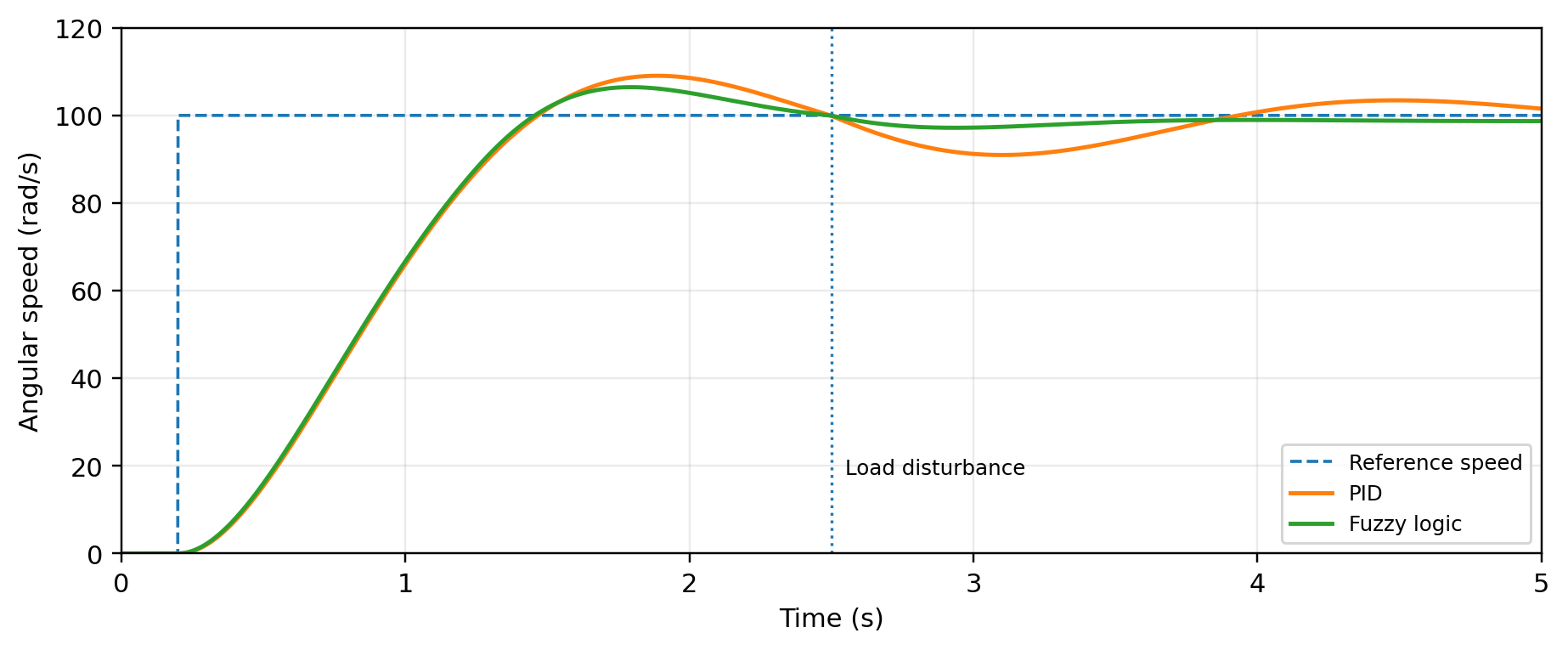
This paper presents a methodology-oriented comparative study of a conventional proportional-integral-derivative (PID) controller and a fuzzy logic controller (FLC) for regulating the speed of a separately excited direct-current motor. The purpose is to establish a reproducible framework in which both controllers are applied to the same nonlinear electromechanical plant, subjected to the same armature-voltage constraint and the same load disturbance, and assessed with identical time-domain performance indices. The DC motor is represented by coupled armature-current and rotor-speed equations. The PID controller uses fixed gains with output saturation and anti-windup logic, whereas the fuzzy controller uses speed error and change of error as linguistic inputs, five membership sets for each input, Mamdani-style rule aggregation, and a bounded voltage correction. A 100 rad/s reference command is applied at 0.2 s and a 0.08 N·m load disturbance is introduced at 2.5 s. In the representative simulation, the FLC reduces overshoot from about 9.05% to 6.45%, settling time from 2.20 s to 2.07 s, disturbance-induced speed drop from about 9.04 rad/s to 2.82 rad/s, and integral absolute error from 81.87 to 72.22. The comparison indicates that fixed-gain PID control remains simple and accurate near the tuned operating point, while fuzzy logic offers stronger disturbance rejection and greater tolerance to operating-condition changes. The methodology is intended as a compact basis for simulation studies and later hardware validation rather than as a claim of experimental testing.