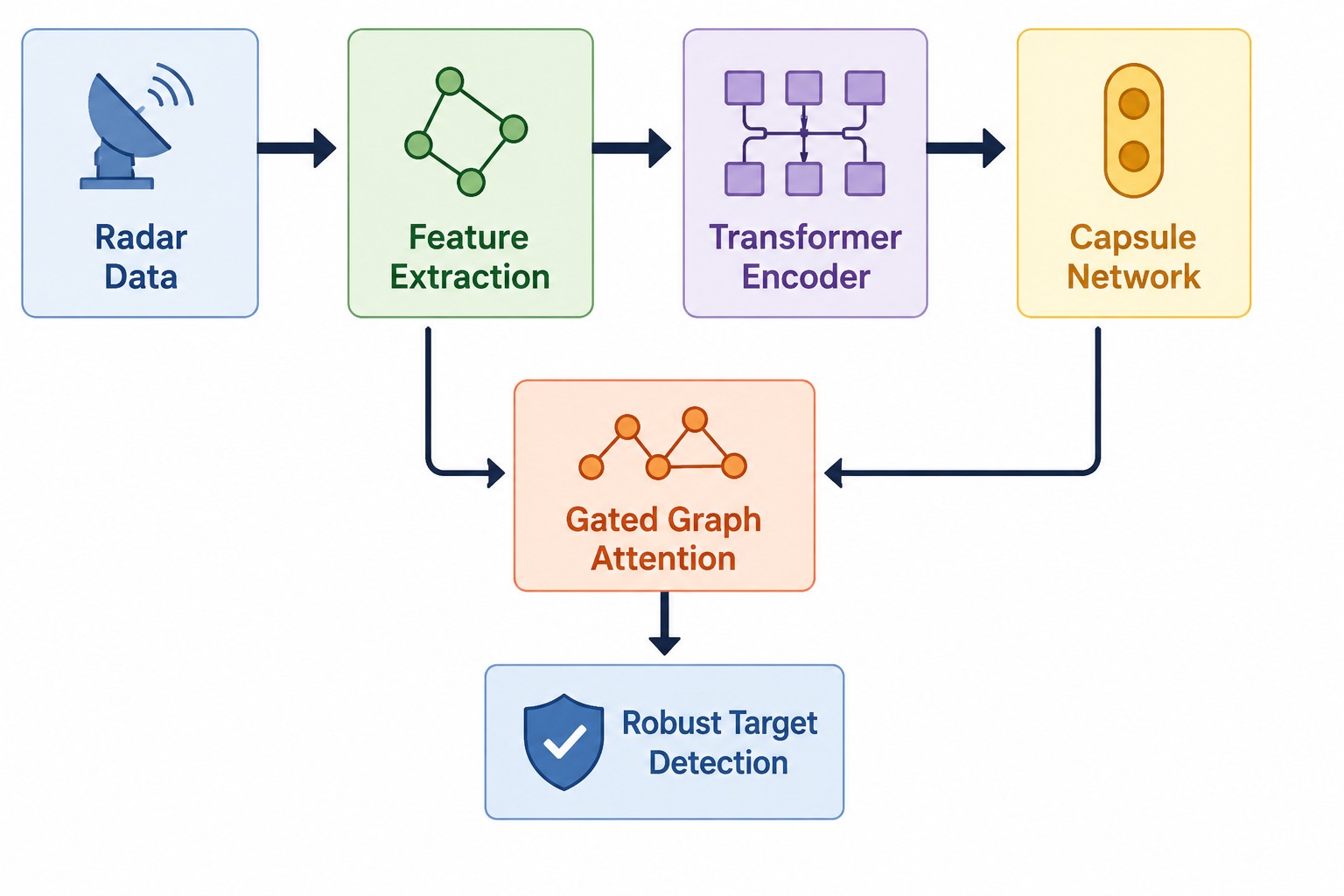
Deep Learning and Optimization Approaches in Hybrid Transformer based Gated Graph Attention Capsule Network Design for Preventing Attack in Radar Target Detection: A Review
Keywords:
Abstract
Deep learning has significantly enhanced radar target detection systems, particularly through Synthetic Aperture Radar (SAR) technologies that support reliable all-weather and day-night surveillance. However, the increasing dependence on deep neural networks has introduced vulnerabilities to adversarial attacks, where minor perturbations in radar signals or images can cause incorrect classifications or missed detections. These threats are especially critical in military surveillance and autonomous defence applications. To improve robustness and security, researchers have developed hybrid deep learning architectures combining transformers, graph attention networks (GAT), and capsule networks (CapsNet). Transformers effectively model long-range spatial dependencies using self-attention mechanisms, while GAT captures relational information among targets and environmental features. Capsule networks preserve hierarchical spatial relationships, enhancing resistance to distortions and noise. The integration of these models into a Hybrid Transformer-based Gated Graph Attention Capsule Network (TGACN) provides improved resilience against adversarial attacks. Recent studies emphasize that conventional CNN and GNN models remain vulnerable to perturbations, highlighting the importance of adaptive and secure AI architectures. This review analyzes recent advancements, optimization strategies, research gaps, and future directions for developing reliable and attack-resistant radar target detection systems.