Deep Learning Approaches for Financial Risk Prediction in E-Commerce Enterprise Systems
Keywords:
Abstract
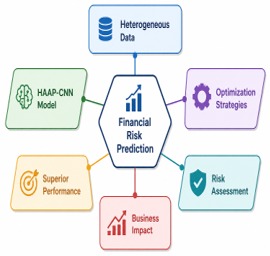
The rapid expansion of e-commerce platforms has significantly increased the complexity of financial risk prediction, necessitating advanced computational models capable of capturing nonlinear, high-dimensional, and dynamic patterns in financial data. Traditional statistical methods often fail to address the intricate interdependencies among operational, transactional, and macroeconomic variables in digital commerce environments. This review examines the application of hierarchical auto-associative polynomial convolutional neural networks (HAAP-CNNs) for financial risk prediction in e-commerce enterprises. The proposed architecture integrates hierarchical feature learning with autoencoder-based representation to extract meaningful patterns from heterogeneous financial datasets. The polynomial convolution mechanism enhances the model’s ability to capture higher-order nonlinear relationships, improving predictive accuracy.The hierarchical design enables multi-scale analysis, allowing simultaneous detection of short-term anomalies and long-term financial instability trends. The study also reviews optimization strategies such as adaptive gradient methods, regularization techniques, and hyperparameter tuning approaches that improve model robustness and convergence. Empirical evaluations across benchmark datasets demonstrate superior performance compared to traditional machine learning and standard deep learning models, particularly in tasks such as credit risk assessment, fraud detection, and bankruptcy prediction.Despite advancements, challenges related to interpretability, scalability, and real-time deployment persist.This review provides a comprehensive overview of emerging methodologies and future directions for developing intelligent and scalable financial risk prediction systems in e-commerce.