Performance Evaluation of MANET Routing Protocols under Dynamic Network Conditions
DOI:
https://doi.org/10.65521/ijacte.v7i1.4627Keywords:
Abstract
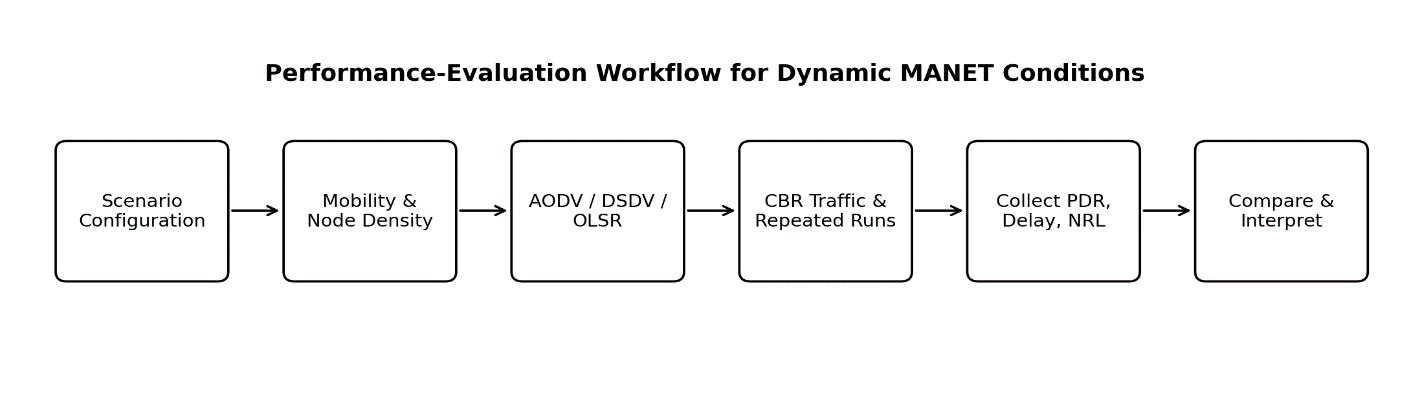
Mobile Ad Hoc Networks (MANETs) operate without fixed infrastructure and therefore depend on mobile nodes to discover, maintain, and repair multi-hop routes. Their performance changes rapidly when node speed, network density, traffic intensity, and wireless connectivity vary. This methodology paper presents a controlled framework for evaluating three widely used MANET routing protocols: Ad Hoc On-Demand Distance Vector (AODV), Destination-Sequenced Distance-Vector (DSDV), and Optimized Link State Routing (OLSR). The proposed study varies node mobility and network density while keeping the radio, traffic, and simulation parameters consistent. Packet delivery ratio, average end-to-end delay, throughput, and normalized routing load are used as performance indicators. The design combines repeated simulation runs with confidence-based aggregation so that protocol behavior can be compared fairly under dynamic conditions. Representative results show the expected trade-off between reactive and proactive routing: AODV remains resilient when topology changes are frequent, DSDV provides low route-lookup latency but incurs periodic-update cost, and OLSR benefits from precomputed routes in denser networks. The framework is suitable for reproducible NS-3-based experimentation and for extending evaluation to energy, congestion, and heterogeneous mobility scenarios.