Performance Analysis of Load Balancing Algorithms in Distributed Computing Environments
DOI:
https://doi.org/10.65521/ijacte.v5i1.4624Keywords:
Abstract
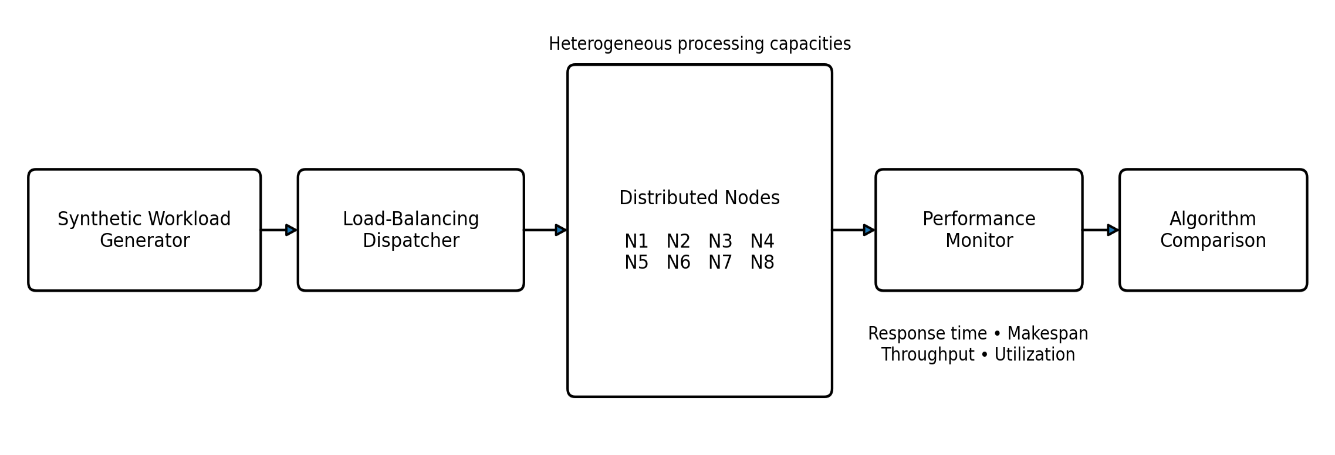
Load balancing is a central resource-management function in distributed computing because uneven task arrival, heterogeneous processor capacities, and variable communication delays can leave some nodes congested while others remain underutilized. This paper presents a methodology for comparing representative load-balancing algorithms under a common and reproducible distributed-computing workload. Five policies are evaluated: Round Robin, Random allocation, Weighted Round Robin, Least-Loaded dispatching, and a dynamic minimum-completion-time policy. A discrete-event simulation models eight heterogeneous processing nodes and 1,200 independent tasks with stochastic inter-arrival times and variable computational demand. Performance is measured through average response time, 95th-percentile response time, makespan, throughput, mean utilization, and utilization imbalance. The methodology also accounts for the monitoring overhead required by dynamic policies. Results show that capacity-aware dynamic selection substantially reduces response time under heterogeneous load, while weighted static allocation provides a useful compromise between simplicity and balanced utilization. The study demonstrates that the most suitable load-balancing policy depends not only on average speed but also on workload variability, communication cost, monitoring overhead, and the level of resource heterogeneity.