Data Mining Techniques for Knowledge Discovery in Large Databases
DOI:
https://doi.org/10.65521/ijacte.v4i1.4598Keywords:
Abstract
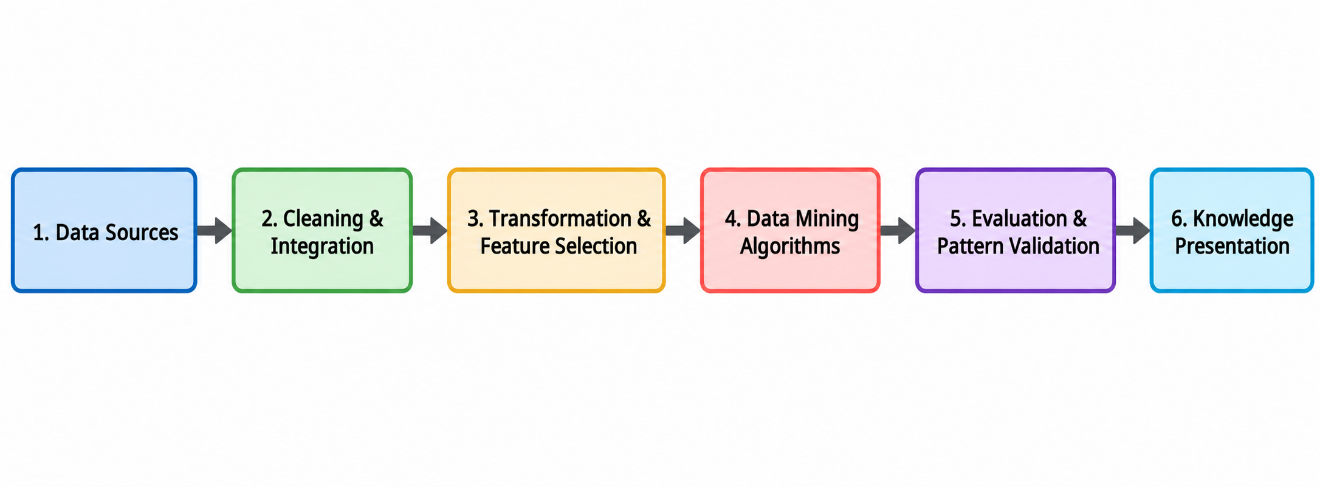
The continuing growth of organizational databases has increased the need for systematic methods that convert large volumes of stored data into useful and understandable knowledge. This methodology paper presents an integrated knowledge discovery in databases (KDD) framework that combines data selection, cleaning, integration, transformation, mining, evaluation, and knowledge presentation. The proposed procedure treats data mining as one stage within the broader KDD cycle rather than as an isolated algorithmic task. It considers supervised classification, clustering, frequent-pattern discovery, anomaly detection, and ensemble learning as complementary techniques selected according to the analytical objective and data characteristics. Particular attention is given to missing values, class imbalance, high dimensionality, model validation, scalability, and interpretability. A controlled prototype experiment on 50,000 records is used to demonstrate the evaluation procedure for classification methods; Random Forest, Decision Tree, and linear support-vector classification are compared using accuracy, precision, recall, F1-score, training time, and prediction time. The results illustrate the methodological trade-off between predictive performance, computational cost, and model simplicity. The framework is intended as a reproducible basis for knowledge discovery studies involving large structured databases and uses literature published no later than 2015.