Intrusion Detection in Computer Networks Using Artificial Neural Network Approaches
DOI:
https://doi.org/10.65521/ijacte.v6i1.4596Keywords:
Abstract
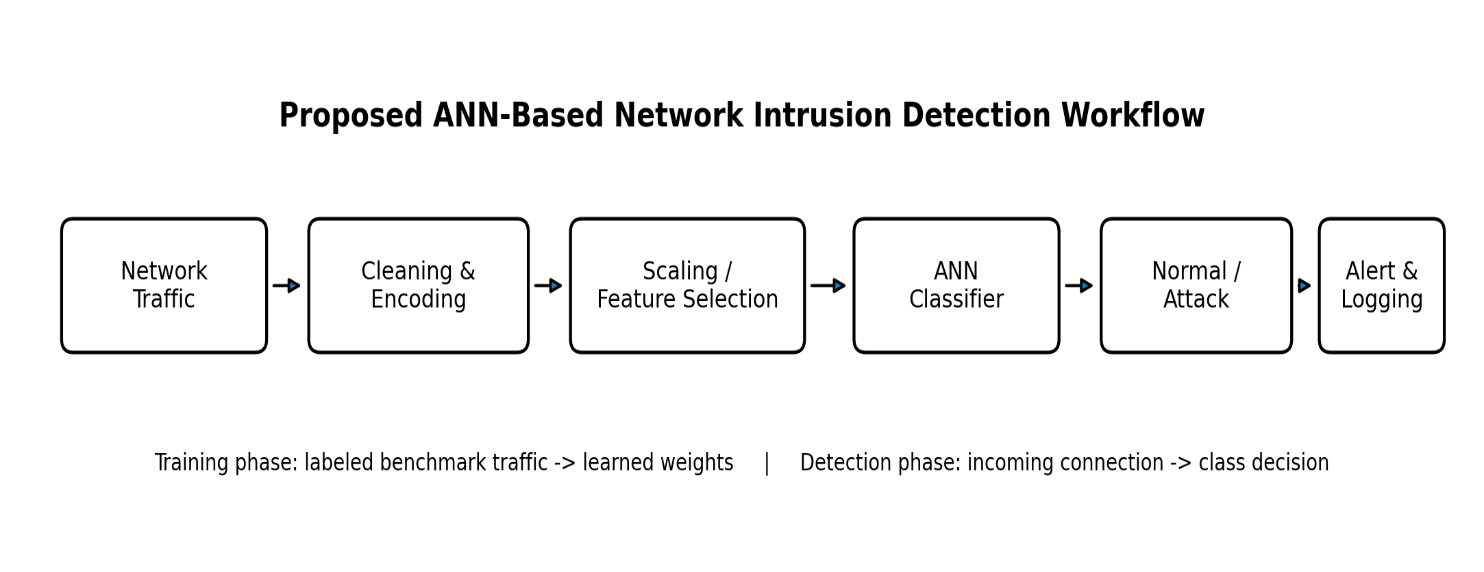
Intrusion detection is a critical layer of network defense because preventive mechanisms such as authentication, access control, and firewalls cannot identify every misuse or previously unseen attack. This methodology paper presents a structured artificial neural network (ANN) approach for classifying network connections as normal or intrusive. The method uses benchmark connection records, categorical encoding, numerical normalization, optional feature selection, supervised ANN training, and evaluation through accuracy, precision, recall, F1-score, detection rate, false-positive rate, and confusion-matrix analysis. The proposed design emphasizes a multilayer perceptron as a transparent baseline while also describing how recurrent or hybrid neural structures can extend the model. NSL-KDD is recommended as the primary benchmark because it reduces duplicate-record effects associated with KDD Cup 99. The method is aligned with ANN-based intrusion-detection research published through 2017. Reported benchmark evidence shows that neural models can learn nonlinear traffic patterns effectively, although class imbalance, low-frequency attacks, changing traffic distributions, and false alarms remain important limitations. The resulting workflow is suitable for a reproducible academic implementation and comparative IDS experimentation.