A Survey of Methods and Architectures for IoT-Based Smart Pharmacies for Optimizing Stock Management with Siamese Heterogeneous Convolutional Neural Networks
DOI:
https://doi.org/10.65521/ijacte.v13i1.3782Keywords:
Abstract
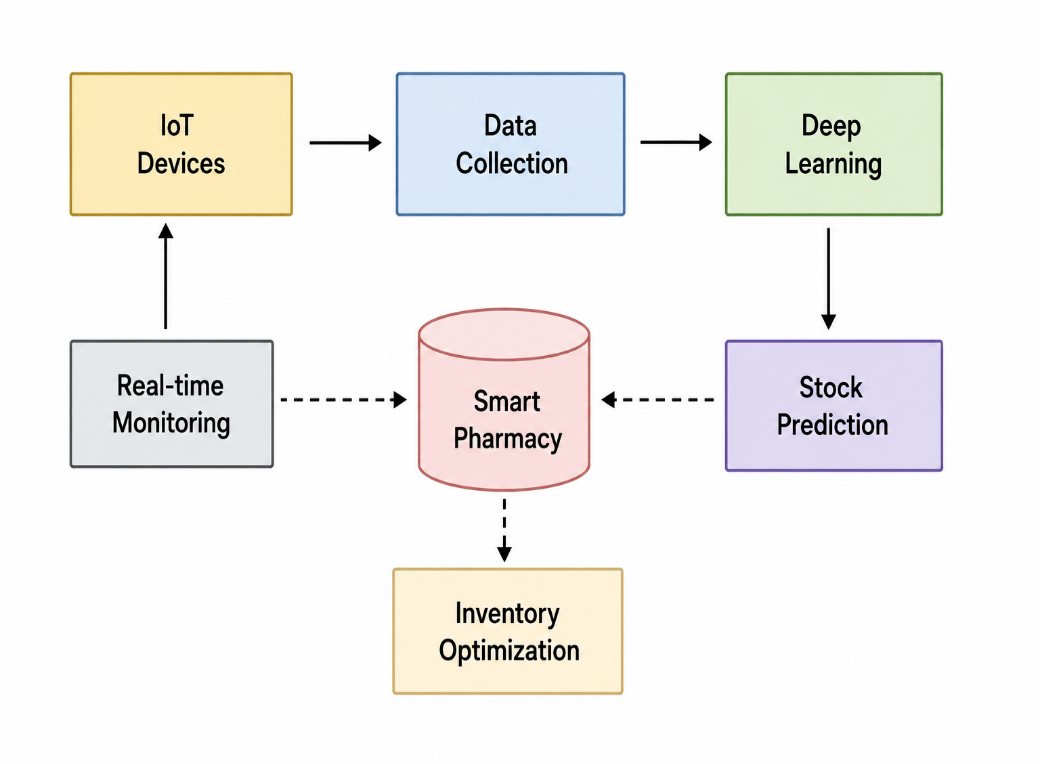
The integration of the Internet of Things (IoT) with artificial intelligence (AI) and deep learning has significantly transformed pharmaceutical inventory management systems. Traditional pharmacy stock management approaches often rely on manual processes and legacy systems, leading to inefficiencies such as inaccurate inventory tracking, drug shortages, overstocking, and medication wastage due to expiration. IoT-based smart pharmacy systems address these challenges by enabling real-time monitoring of inventory using connected devices such as sensors, RFID tags, and smart shelves. These systems generate continuous streams of data that can be analyzed using advanced machine learning and deep learning techniques.Recent advancements in deep learning, particularly convolutional neural networks (CNNs) and Siamese architectures, have shown promising results in analyzing complex pharmaceutical datasets. Siamese Heterogeneous Convolutional Neural Networks (SHCNNs) are especially effective in learning similarity relationships between historical and real-time inventory data, enabling accurate demand forecasting, anomaly detection, and intelligent stock classification. IoT-enabled systems combined with AI-driven analytics have demonstrated improvements in inventory accuracy, reduction in stockouts, and enhanced operational efficiency. This survey reviews methods and architectures used in IoT-based smart pharmacy systems, focusing on stock optimization strategies. It explores the integration of IoT with AI, blockchain, and edge computing technologies, highlighting their role in improving supply chain transparency and decision-making. The study also identifies challenges such as data security, interoperability, and implementation costs. The findings indicate that IoT-AI integrated systems significantly enhance pharmacy operations by enabling predictive analytics and automation. Future research directions include hybrid deep learning models, federated learning for secure data sharing, and edge-based architectures for real-time decision-making in smart healthcare environments.