Artificial Intelligence Techniques for Dual-Stage EV Onboard Chargers Using Hybrid Adaptive Optimization: Trends and Challenges
DOI:
https://doi.org/10.65521/ijacte.v12i1.3800Keywords:
Abstract
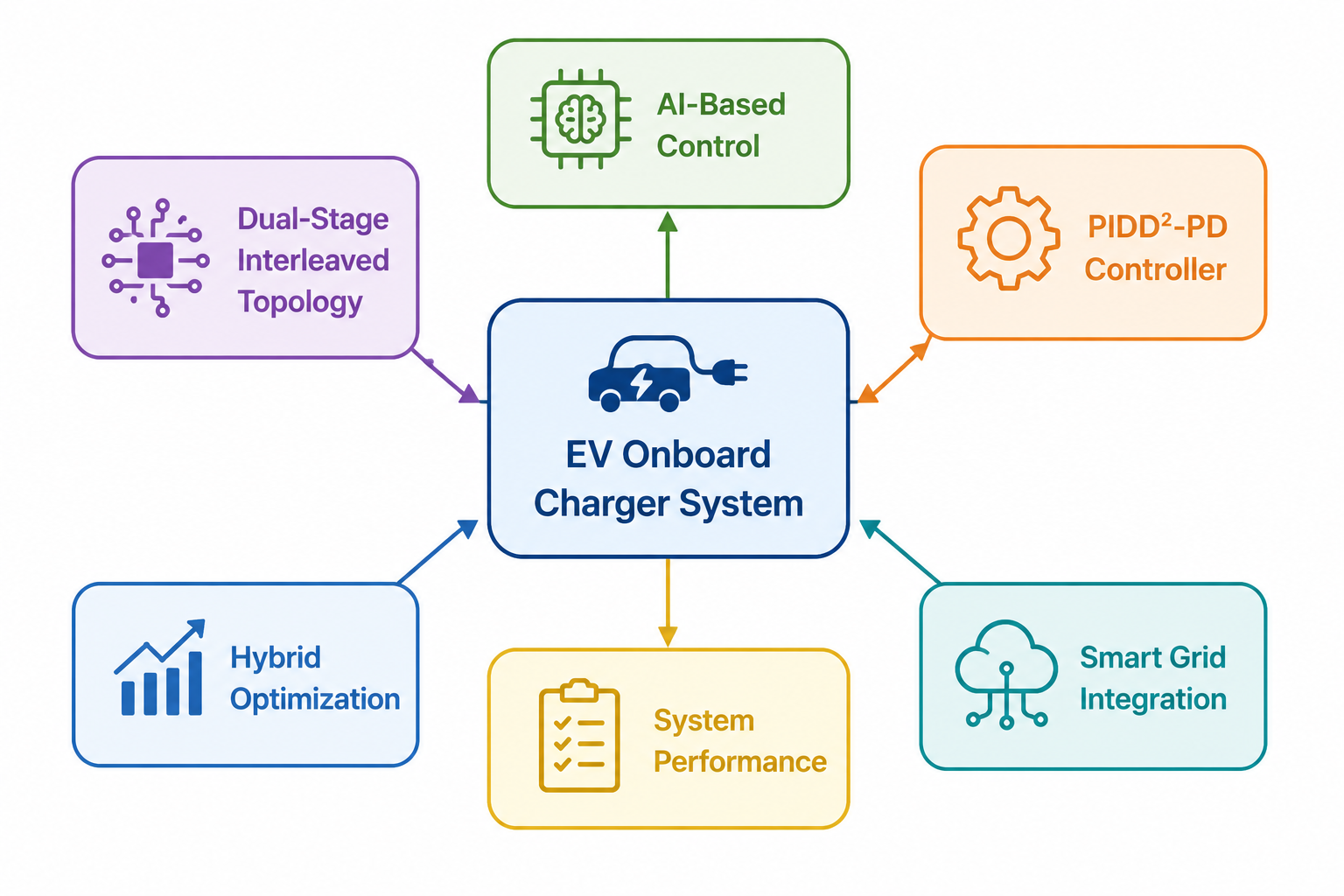
The electrification of transportation has accelerated the demand for efficient and intelligent onboard charging systems for electric vehicles (EVs). Dual-stage interleaved onboard chargers have gained prominence due to their high efficiency, reduced current ripple, and improved power quality. However, their nonlinear dynamics and varying operating conditions pose significant challenges for conventional control methods. This review examines the application of artificial intelligence (AI) techniques in the design, control, and optimization of dual-stage interleaved onboard chargers. It highlights the role of advanced controllers, particularly the PIDD2-PD controller, in enhancing transient response, stability, and disturbance rejection. AI approaches, including deep learning and reinforcement learning, are explored for modeling system behavior, predicting load variations, and enabling adaptive control. Additionally, hybrid metaheuristic optimization methods such as the Adaptive Genghis Khan Shark Gold Rush algorithm are analyzed for efficient parameter tuning and multi-objective optimization. These approaches improve convergence speed, robustness, and global optimality. The study also discusses applications in fault detection, predictive maintenance, and energy management, along with key challenges such as computational complexity and data requirements. Overall, AI-driven frameworks offer a scalable and intelligent solution for next-generation EV charging systems.