Artificial Intelligence Techniques for an Effective Progressive Dense Self-Attention Based Human Resource Recommendation for Predicting Employee Turnover: Trends and Challenges
DOI:
https://doi.org/10.65521/ijacte.v13i1.3774Keywords:
Abstract
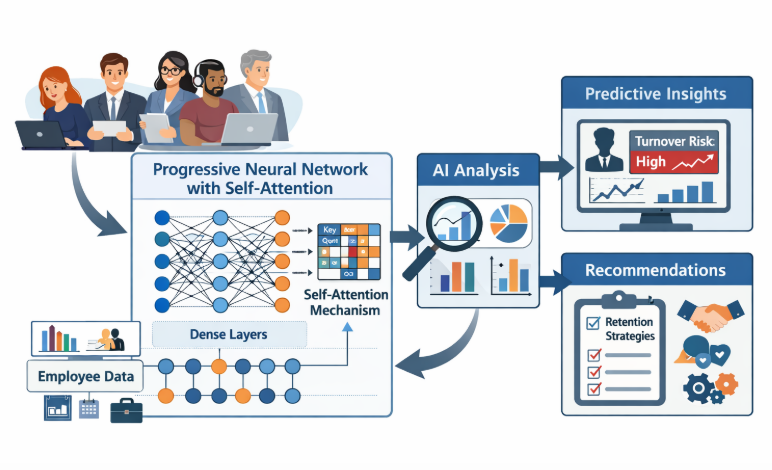
Employee turnover prediction has emerged as a critical concern for organizations aiming to maintain workforce stability and optimize human resource management. With the increasing availability of organizational data, artificial intelligence techniques have gained prominence in identifying patterns and predicting employee attrition. This study presents a comprehensive exploration of advanced AI-driven methodologies, focusing on progressive dense architectures integrated with self-attention mechanisms for enhanced human resource recommendation systems. The proposed paradigm leverages deep learning models to capture complex feature interactions, temporal dependencies, and contextual relationships within employee datasets. Progressive dense networks facilitate efficient feature propagation and mitigate vanishing gradient issues, while self-attention mechanisms enable the model to prioritize significant attributes influencing employee behavior. This paper reviews recent trends in AI-based turnover prediction, highlighting the evolution from traditional machine learning models to sophisticated deep neural architectures. Furthermore, it addresses key challenges such as data imbalance, interpretability, ethical concerns, and scalability. The study emphasizes the integration of recommendation systems with predictive models to provide actionable insights for employee retention strategies. By synthesizing current advancements and identifying research gaps, this work contributes to the development of intelligent, adaptive, and explainable HR analytics systems capable of improving organizational decision-making and workforce sustainability.