Secure Data Transmission Techniques in Wireless Sensor Networks
DOI:
https://doi.org/10.65521/ijacte.v5i1.4625Keywords:
Abstract
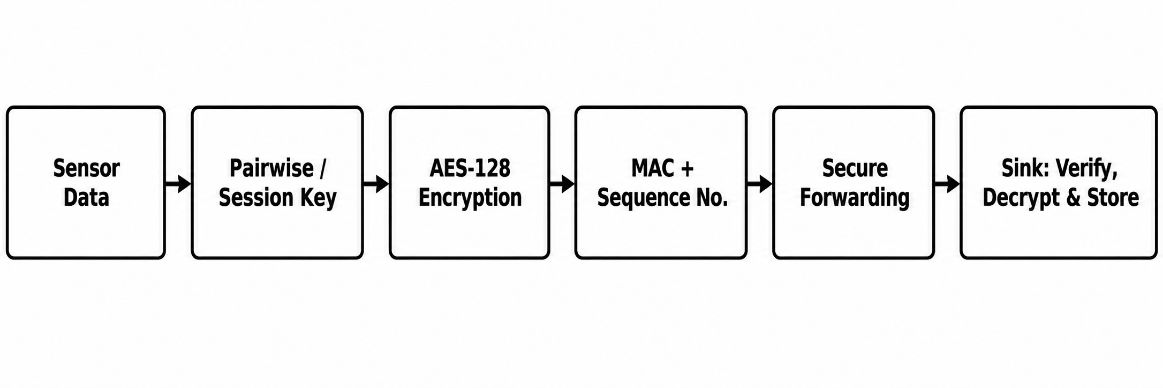
Wireless sensor networks (WSNs) collect and forward information through low-power nodes that operate with restricted memory, computation, bandwidth, and battery capacity. These constraints make conventional security mechanisms difficult to deploy without degrading network lifetime. This methodology paper presents a lightweight framework for secure data transmission in WSNs by combining pairwise/session-key establishment, symmetric encryption, message authentication, packet freshness, and secure forwarding. The design uses AES-128 for confidentiality, a truncated message authentication code for integrity and source verification, and a sequence counter to prevent replay. Key establishment is organized around localized pairwise relationships so that the impact of node compromise is restricted. The proposed methodology is evaluated through a reproducible analytical packet-level model that compares unsecured transmission, encryption-only protection, encryption with authentication, and the complete layered framework. The evaluation considers security coverage, packet overhead, delivery behavior, relative energy cost, and acceptance of malicious traffic. Results from the model show that adding authentication and freshness provides substantially stronger protection than encryption alone while keeping the communication overhead within a range suitable for resource-constrained sensor nodes. The paper therefore emphasizes balanced security rather than maximum cryptographic complexity, and it provides a practical experimental procedure that can be implemented in TinyOS, Contiki, NS-2/NS-3, or a physical IEEE 802.15.4 testbed.