Green Synthesis of Silver Nanoparticles Using Plant Extracts and Evaluation of Their Antibacterial Activity
DOI:
https://doi.org/10.65521/ijacsa.v7i1.4371Keywords:
Abstract
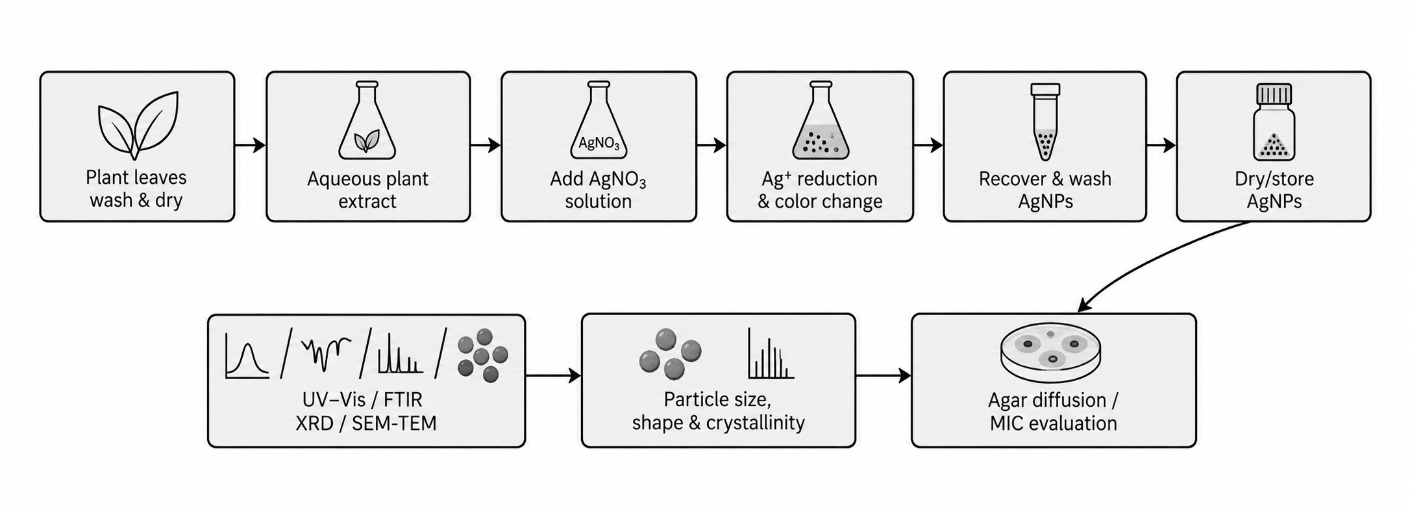
Green synthesis of silver nanoparticles (AgNPs) using plant extracts offers an environmentally preferable alternative to conventional chemical reduction because naturally occurring phenolics, flavonoids, terpenoids, proteins and sugars can simultaneously reduce Ag+ ions and stabilize the resulting nanostructures. This methodology paper proposes a reproducible experimental framework for synthesizing AgNPs using aqueous Ocimum sanctum (Tulsi) leaf extract and evaluating their antibacterial activity. Fresh leaves are washed, dried and extracted in deionized water; the filtered extract is reacted with aqueous silver nitrate under controlled extract-to-salt ratio, pH, temperature and reaction time. Nanoparticle formation is followed by visual color change and UV–visible spectroscopy, while Fourier-transform infrared spectroscopy, X-ray diffraction, scanning/transmission electron microscopy and particle-size analysis are used to determine surface functional groups, crystallinity, morphology and size. Antibacterial efficacy is evaluated against representative Gram-negative Escherichia coli and Gram-positive Staphylococcus aureus using agar diffusion and minimum inhibitory concentration approaches, with plant-extract, silver-salt and antibiotic controls. Literature available up to 2018 shows that plant-mediated AgNPs frequently exhibit spherical morphology, characteristic surface-plasmon absorption in the visible region and measurable antibacterial effects. The proposed methodology integrates synthesis, characterization, biological evaluation, statistical analysis and quality-control steps in a single workflow and can be adapted to other medicinal plant extracts.