Synthesis and Spectral Characterization of Transition Metal Complexes Derived from Schiff Base Ligands
DOI:
https://doi.org/10.65521/ijacsa.v4i1.4307Keywords:
Abstract
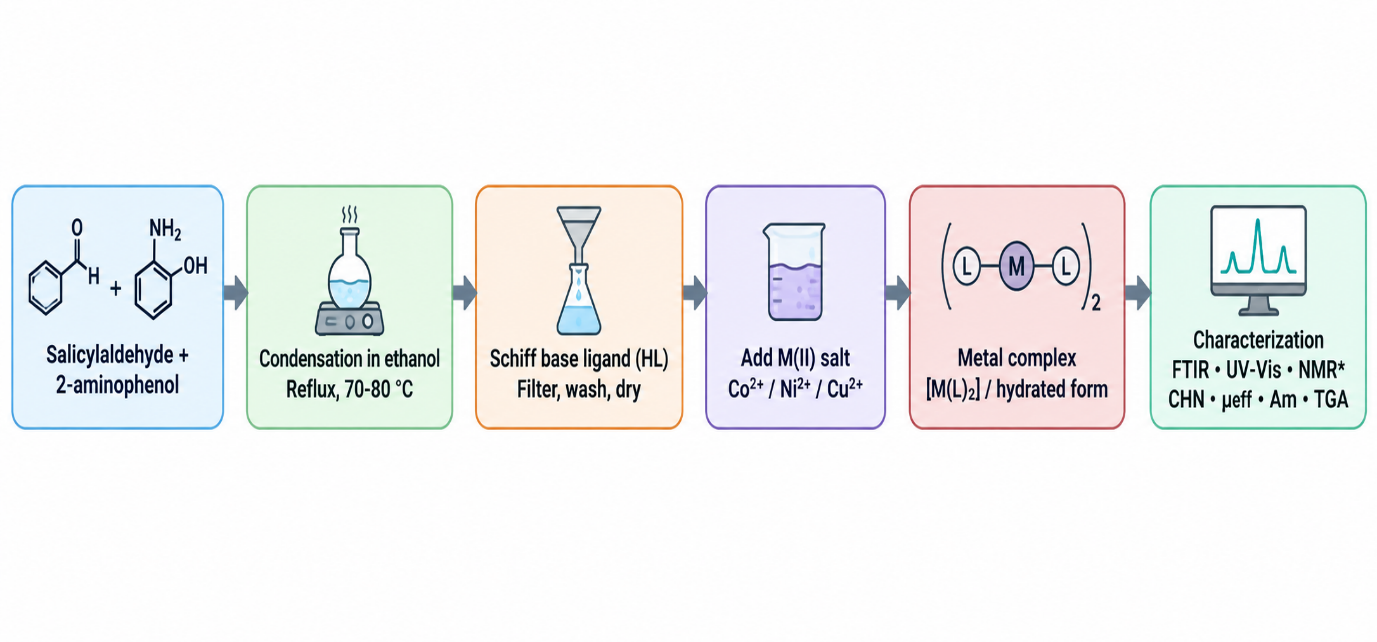
Schiff base ligands are versatile imine-containing chelators whose donor atoms can stabilize transition-metal ions in several coordination environments. This methodology paper presents a reproducible laboratory strategy for the synthesis and spectral characterization of Co(II), Ni(II), and Cu(II) complexes derived from a representative salicylaldehyde–2-aminophenol Schiff base. The ligand is prepared by condensation in ethanol and subsequently reacted with divalent metal salts under controlled stoichiometric and reflux conditions. The proposed characterization sequence combines elemental composition, molar conductivity, Fourier-transform infrared (FTIR) spectroscopy, UV–visible spectroscopy, proton nuclear magnetic resonance (for the free ligand), magnetic susceptibility, mass spectrometry and thermogravimetric analysis. Coordination is evaluated primarily from the shift of the azomethine ν(C=N) band, disappearance or displacement of phenolic O–H features, emergence of low-frequency M–N/M–O bands, ligand-field transitions, magnetic moments and conductivity. An illustrative validation dataset is included to demonstrate data processing and interpretation without claiming unperformed laboratory measurements. The integrated method provides a compact framework for assigning stoichiometry, donor atoms and probable geometry while emphasizing that definitive structural claims should be supported by diffraction where available. The workflow is suitable for postgraduate inorganic and coordination-chemistry laboratories and can be adapted to substituted Schiff bases and other first-row transition metals.