Production and Characterization of Bioethanol from Agricultural Waste Materials
DOI:
https://doi.org/10.65521/ijacsa.v5i1.4360Keywords:
Abstract
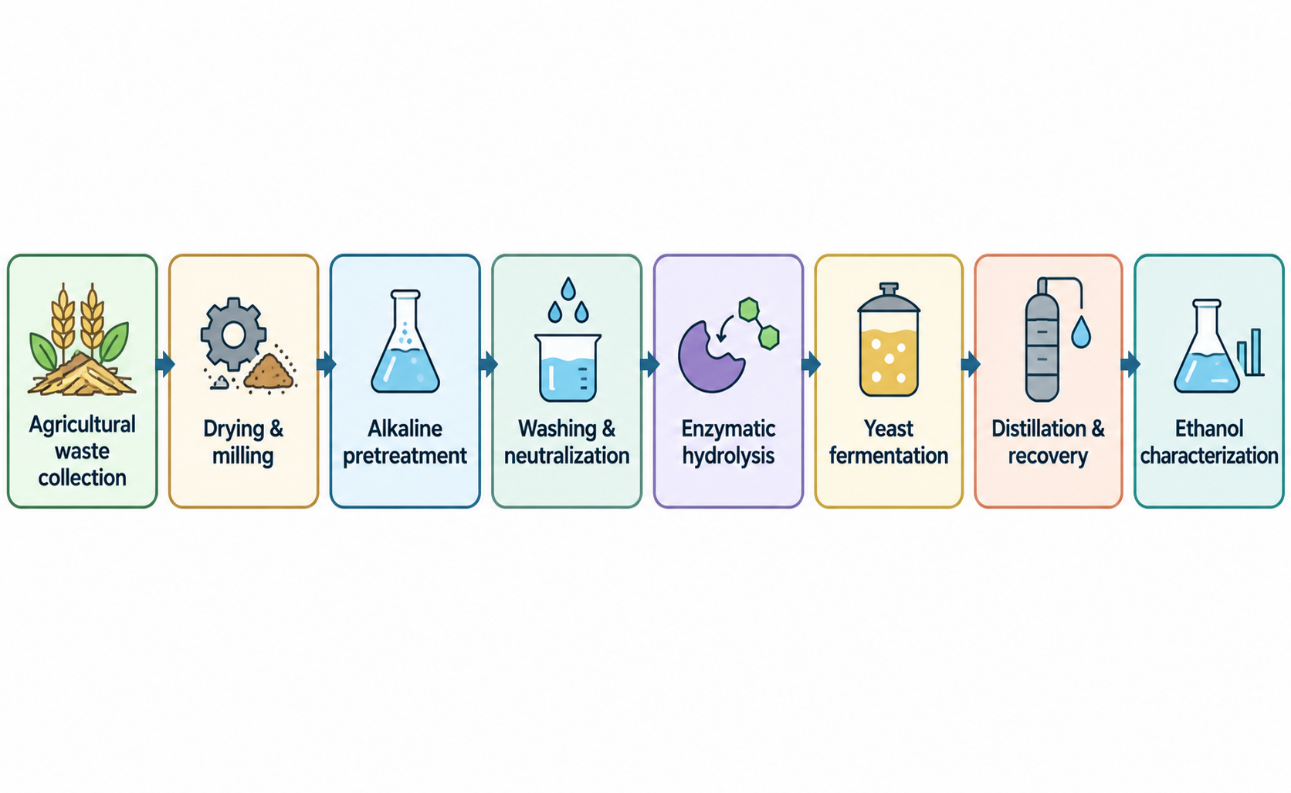
Agricultural residues are abundant lignocellulosic resources that can be converted into second-generation bioethanol while reducing open burning and dependence on edible feedstocks. This methodology paper develops a comparative laboratory framework for production and characterization of bioethanol from rice straw, wheat straw, and sugarcane bagasse. The process consists of feedstock preparation, alkaline pretreatment, enzymatic hydrolysis, fermentation with Saccharomyces cerevisiae, ethanol recovery by fractional distillation, and physicochemical characterization. Pretreatment is designed to reduce lignin-associated recalcitrance and increase cellulose accessibility, whereas cellulase and beta-glucosidase convert exposed polysaccharides to fermentable sugars. Fermentation performance is evaluated from reducing-sugar utilization, ethanol concentration, yield, productivity, and theoretical fermentation efficiency. Recovered ethanol is characterized by alcohol strength, density, refractive index, Fourier-transform infrared spectroscopy and, where available, gas chromatography. An illustrative methodology-validation dataset is presented to demonstrate data handling; it indicates increasing hydrolysate sugar concentration and ethanol production in the order rice straw < wheat straw < sugarcane bagasse, with the bagasse system reaching 27.6 g/L ethanol and approximately 91.9% theoretical fermentation efficiency. These values are not reported as original experimental observations, but as worked examples showing how the proposed protocol can be analyzed. The integrated approach provides a reproducible basis for comparing agricultural wastes and identifying process bottlenecks related to delignification, enzymatic digestibility, fermentation inhibition, and ethanol recovery. The method is suitable for small-scale academic studies and can be extended to optimization studies involving pretreatment severity, enzyme loading, solids concentration, yeast dose, temperature and fermentation time.