Development of Eco-Friendly Catalysts for Sustainable Organic Synthesis Reactions
DOI:
https://doi.org/10.65521/ijacsa.v11i1.4131Abstract
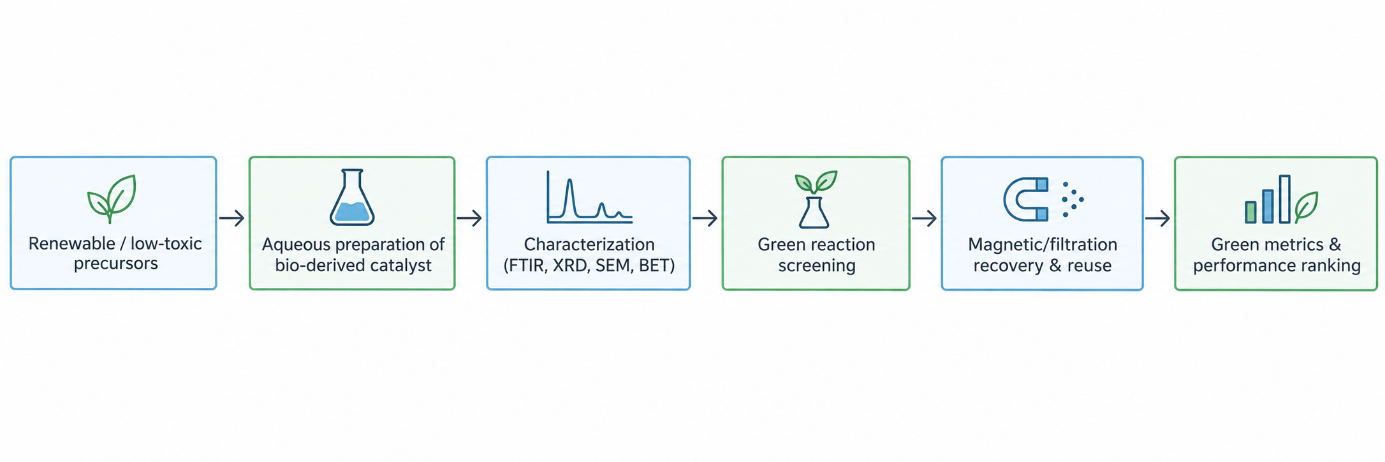
Sustainable organic synthesis requires catalysts that provide high activity and selectivity while reducing hazardous reagents, solvent consumption, energy demand, metal contamination and solid waste. This methodology paper proposes a systematic framework for developing and evaluating an eco-friendly, reusable heterogeneous catalyst for representative carbon–carbon bond-forming reactions. The proposed platform uses a renewable biopolymer support, chitosan, combined with magnetite (Fe3O4) to obtain a recoverable chitosan–magnetite (CS–Fe3O4) catalyst. The synthesis is intentionally designed around aqueous processing, inexpensive iron salts, dilute acetic acid and moderate temperatures, avoiding noble metals and minimizing volatile organic solvents. Catalyst performance is evaluated using a model Knoevenagel condensation between aromatic aldehydes and active methylene compounds in water–ethanol media. Experimental variables include catalyst loading, solvent composition, temperature, reaction time and substrate ratio. Characterization by FTIR, XRD, SEM/EDS, BET surface-area analysis and magnetic-recovery testing is integrated with catalytic measurements of conversion, isolated yield, selectivity, turnover performance and recyclability. Sustainability is assessed through atom economy, reaction mass efficiency, process mass intensity and E-factor. A literature-guided benchmark indicates that heterogeneous recovery, greener solvents, alternative activation methods and catalyst reuse are central to reducing the environmental burden of synthetic chemistry. The framework therefore combines catalytic performance with quantitative green metrics instead of treating yield as the only optimization criterion. Representative methodology-validation data suggest that a reusable catalyst can maintain high product yield over repeated cycles while substantially reducing catalyst loss and process waste. The proposed methodology is suitable for laboratory-scale validation and can be extended to multicomponent, condensation and selected oxidation or coupling reactions after catalyst-specific optimization.