Preparation and Evaluation of Activated Carbon from Agricultural Waste for Wastewater Treatment
DOI:
https://doi.org/10.65521/ijacsa.v4i1.4310Keywords:
Abstract
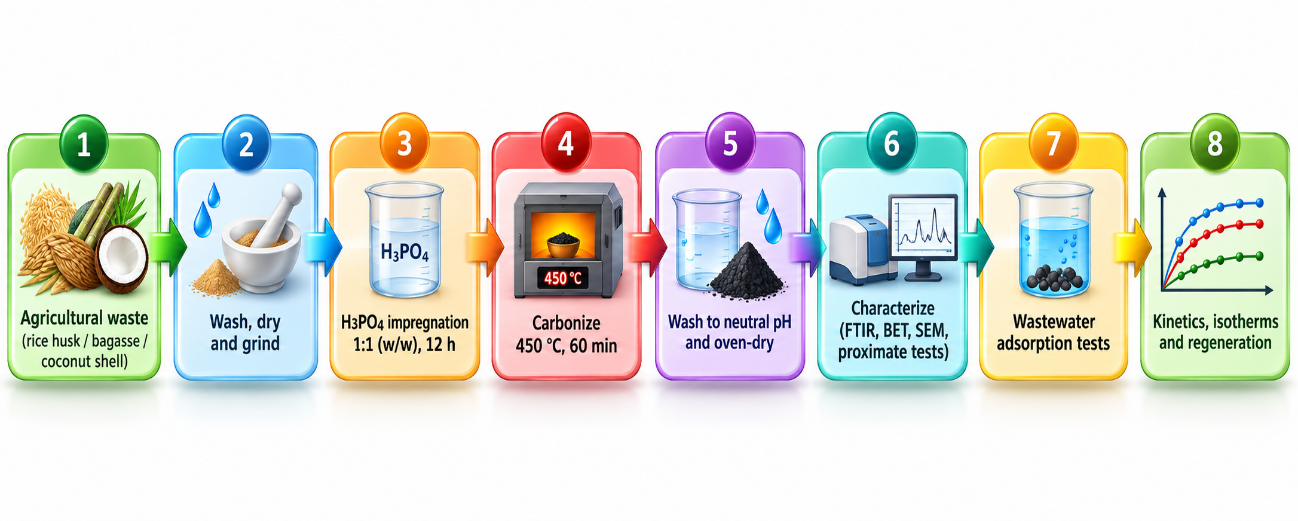
Agricultural residues are inexpensive lignocellulosic precursors for producing porous activated carbon, allowing waste valorization and low-cost wastewater treatment in a single process. This methodology paper presents a reproducible route for preparing activated carbon from rice husk, sugarcane bagasse and coconut shell by phosphoric-acid-assisted carbonization, followed by physicochemical characterization and adsorption evaluation. The proposed procedure includes precursor cleaning, size reduction, impregnation with H3PO4, controlled carbonization at 450 °C, neutral washing, drying and particle-size classification. Product quality is assessed by yield, moisture, ash, iodine number, pH, surface functional groups, morphology and, where available, BET surface area. Adsorptive performance is evaluated with methylene blue as a model wastewater contaminant using batch tests, kinetic fitting and Langmuir/Freundlich equilibrium models. The design also includes regeneration over repeated cycles. The approach is based on activated-carbon studies reported up to 2015 and is suitable for laboratory-scale comparison of agricultural wastes. Illustrative results show how precursor composition and activation conditions can influence carbon yield, porosity and pollutant uptake; these values are provided only to demonstrate data treatment and must be replaced by experimentally measured values in an actual study.