Production of Biodiesel from Waste Cooking Oil and Assessment of Fuel Properties
DOI:
https://doi.org/10.65521/ijacsa.v4i1.4313Keywords:
Abstract
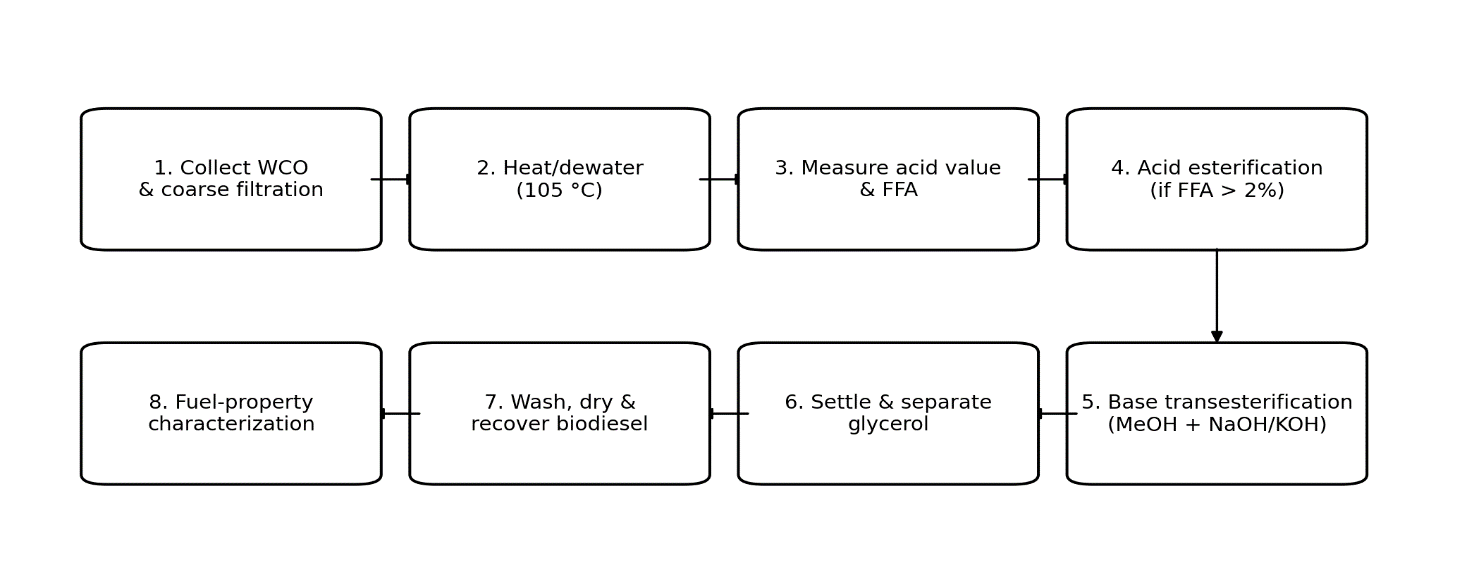
Waste cooking oil (WCO) is an inexpensive lipid feedstock whose conversion to biodiesel can simultaneously reduce disposal problems and lower the raw-material cost of renewable diesel substitutes. This methodology paper presents a reproducible laboratory route for producing fatty acid methyl esters (FAME) from WCO and evaluating the principal fuel properties of the recovered biodiesel. The proposed procedure begins with filtration and dewatering, followed by acid-value determination to decide whether an acid esterification pretreatment is required. High-FFA oil is esterified with methanol and sulfuric acid before alkaline transesterification with methanol and NaOH/KOH. After phase separation, washing and drying, biodiesel yield and properties including density, kinematic viscosity, acid value, flash point, cloud point, pour point and calorific value are determined. An illustrative validation dataset gives a biodiesel yield of 92.4%, density of 0.879 g cm−3, viscosity of 4.62 mm2 s−1 at 40 °C and acid value of 0.42 mg KOH g−1. The protocol integrates the main process lessons reported for waste-oil biodiesel up to 2015 and provides a compact framework suitable for laboratory-scale optimization and fuel-quality assessment.