Assessment of Water Quality Parameters in Urban and Rural Drinking Water Sources
DOI:
https://doi.org/10.65521/ijacsa.v5i1.4358Keywords:
Abstract
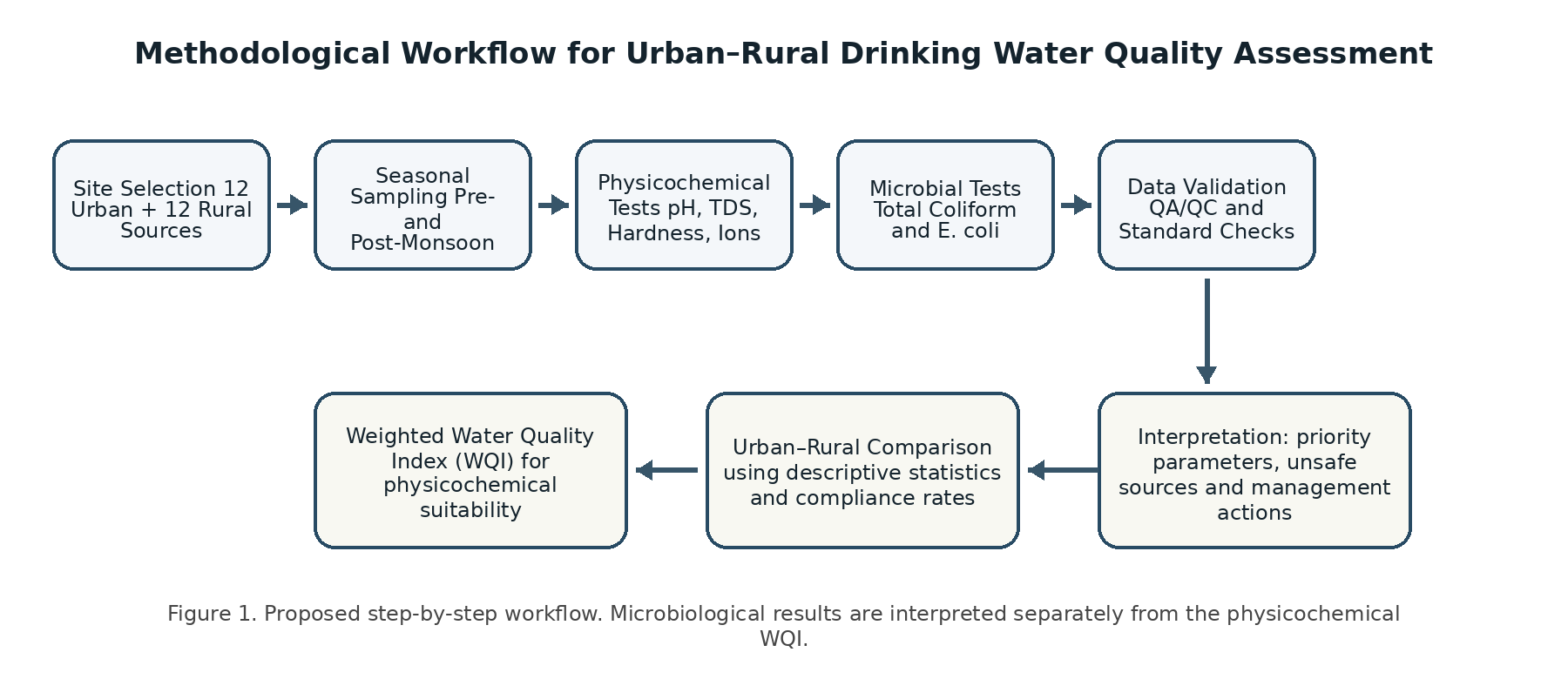
Safe drinking water requires simultaneous control of physicochemical constituents and microbial contamination, yet the nature of risk can differ between urban and rural supply systems. This methodology paper presents a comparative framework for assessing water quality in representative urban and rural drinking-water sources using field measurements, laboratory analysis, a weighted water quality index (WQI), and microbiological compliance. Twenty-four sources are proposed, comprising twelve urban sources and twelve rural sources, with sampling during pre-monsoon and post-monsoon periods. The analytical programme covers pH, turbidity, electrical conductivity, total dissolved solids, alkalinity, total hardness, chloride, sulphate, nitrate, fluoride, iron, total coliforms and Escherichia coli. Physicochemical suitability is summarized using a weighted arithmetic WQI, while microbial contamination is interpreted separately because fecal indicators have a zero-tolerance public-health significance. The design also compares seasonal and settlement-related patterns using descriptive statistics and source-level compliance rates. An illustrative validation dataset shows generally acceptable pH and major-ion chemistry, but relatively higher nitrate, fluoride, hardness and microbial non-compliance in rural sources and somewhat higher dissolved solids in urban sources. The proposed procedure integrates source characterization, quality assurance, chemical assessment, microbial testing and risk-oriented interpretation in a form suitable for community water surveillance and comparative research. The framework is intended for field application after substitution of actual laboratory measurements for the illustrative values reported here.