Performance Evaluation of 5G Network Slicing and Edge Computing for Heterogeneous Smart-City Services
Keywords:
Abstract
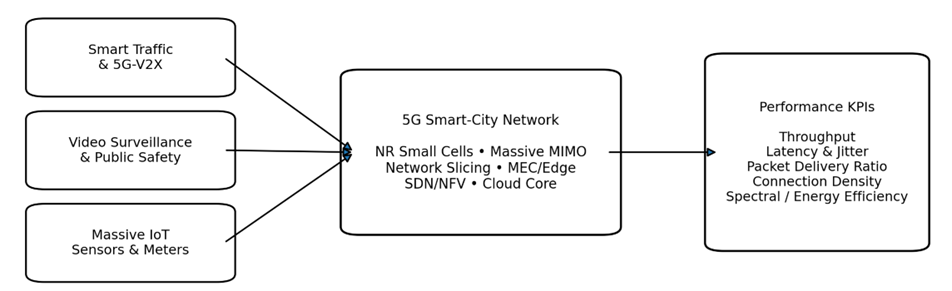
Smart-city communication networks must simultaneously support heterogeneous services with substantially different requirements for throughput, latency, reliability, connection density, and energy efficiency. This study presents a simulation-based methodology for evaluating the performance of 5G network slicing and multi-access edge computing under mixed urban application traffic. The proposed framework considers smart traffic and vehicle-to-everything communication, high-definition video surveillance, massive Internet of Things sensing, emergency-response traffic, and public broadband as representative service classes. A 5G NR smart-city topology is modeled using ns-3 with macro and small-cell coverage, mobile and fixed user equipment, edge and remote-cloud servers, and separate eMBB-, mMTC-, and URLLC-oriented service configurations. Network performance is evaluated using end-to-end throughput, latency, jitter, packet-delivery ratio, connection density, spectral efficiency, and energy efficiency while varying device density, offered load, mobility, radio bandwidth, small-cell density, slice allocation, and compute placement. The methodology compares shared best-effort resources with dedicated or weighted slicing and evaluates remote-cloud processing against MEC placement for delay-sensitive applications. Illustrative results show that heavy shared load can increase V2X latency from 8 ms under light conditions to 31 ms, whereas slicing reduces the corresponding heavy-load latency to approximately 13 ms while restoring packet-delivery ratio from 96.8% to 99.2%. For emergency traffic, moving the application from a remote cloud to MEC reduces illustrative end-to-end latency from 38 ms to 11 ms. These results demonstrate the expected analytical workflow rather than measured deployment performance. The proposed framework provides a reproducible basis for determining how network slicing, edge placement, and traffic load affect the ability of 5G systems to satisfy heterogeneous smart-city quality-of-service requirements.