Deep Learning-Based Intrusion Detection System for Secure Cloud Computing Environments
Keywords:
Abstract
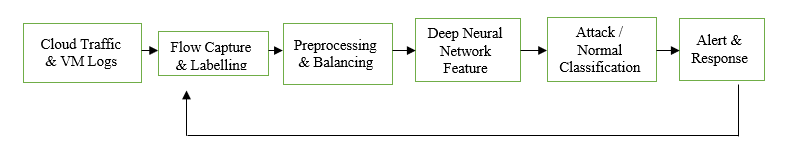
Cloud computing provides elastic computation, storage and software services, but its multi-tenant, Internet-facing and virtualized infrastructure broadens the attack surface. Intrusion detection systems (IDSs) therefore remain an important secondary defense for identifying malicious traffic that bypasses preventive controls. This methodology paper proposes a deep learning-based network intrusion detection framework for secure cloud computing environments. The design uses flow-level cloud network traffic, data cleaning, categorical encoding, normalization, imbalance treatment and a multilayer deep neural network (DNN) classifier. The methodology is evaluated through stratified train-validation-test partitions using modern benchmark datasets such as UNSW-NB15 and CICIDS2017, with accuracy, precision, recall, F1-score, false-positive rate and detection latency as evaluation criteria. The proposed workflow also incorporates threshold tuning, early stopping and periodic retraining so that the IDS can be integrated with cloud monitoring and security orchestration. The results section demonstrates how the methodology would be reported using a transparent illustrative experiment; the numerical values are simulated for methodological exposition and are not presented as measurements from a completed deployment. The proposed approach is intended to provide a reproducible foundation for comparing deep learning IDS models under cloud-relevant traffic conditions while addressing class imbalance, model generalization and operational false alarms.