Machine Learning-Based Network Intrusion Detection System for Secure Communication Networks
Keywords:
Abstract
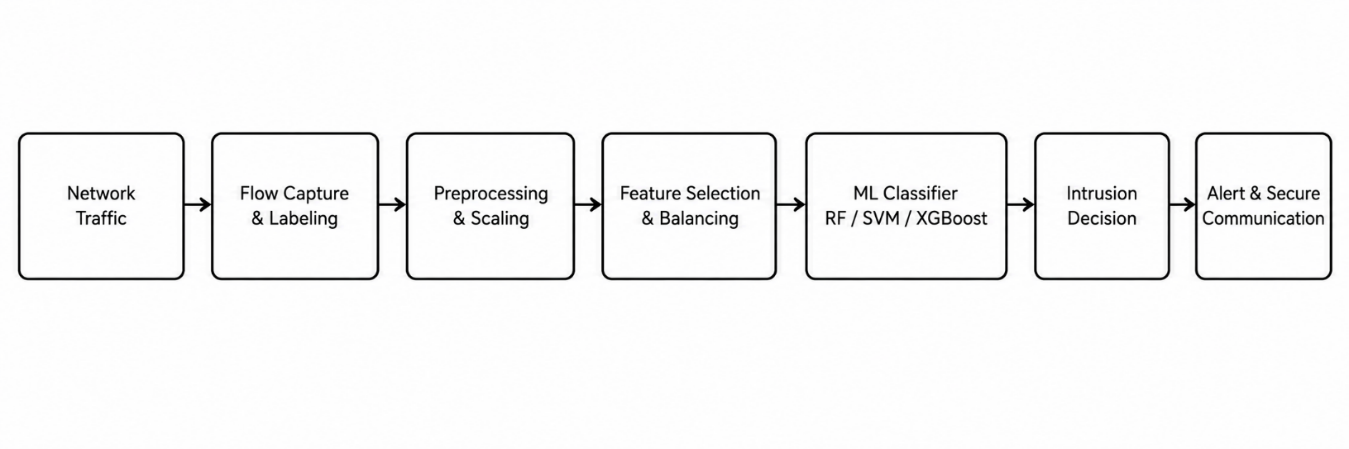
The rapid expansion of Internet services, cloud platforms, mobile systems, and machine-to-machine communication has increased the attack surface of modern communication networks. Signature-based intrusion detection remains useful for previously observed threats, but its dependence on predefined rules limits its ability to detect new or rapidly evolving attacks. This methodology paper presents a machine learning-based network intrusion detection system (ML-NIDS) for secure communication networks. The proposed workflow converts raw network flows into a structured feature space, removes redundant and noisy attributes, addresses class imbalance, trains multiple supervised learning algorithms, and selects a final classifier using accuracy, precision, recall, F1-score, false-positive rate, and inference latency. The methodology is designed around public benchmark data such as UNSW-NB15 and CICIDS2017, whose traffic profiles contain normal sessions and contemporary attack families. Random Forest, Support Vector Machine, k-Nearest Neighbour, XGBoost-style gradient boosting, and a multilayer perceptron are considered as candidate models. The design also incorporates stratified train-test separation, cross-validation, normalization, feature ranking, and confusion-matrix analysis to reduce optimistic bias. A real-time deployment layer converts trained predictions into alerts that can support access control, traffic filtering, and incident response. Illustrative benchmark-style results show that ensemble tree models can achieve a favorable balance between detection accuracy and processing overhead. The methodology provides a reproducible foundation for evaluating ML-based intrusion detection before implementation in operational secure communication networks.