Performance Optimization of Software-Defined Networks for Next-Generation Communication Systems
Keywords:
Abstract
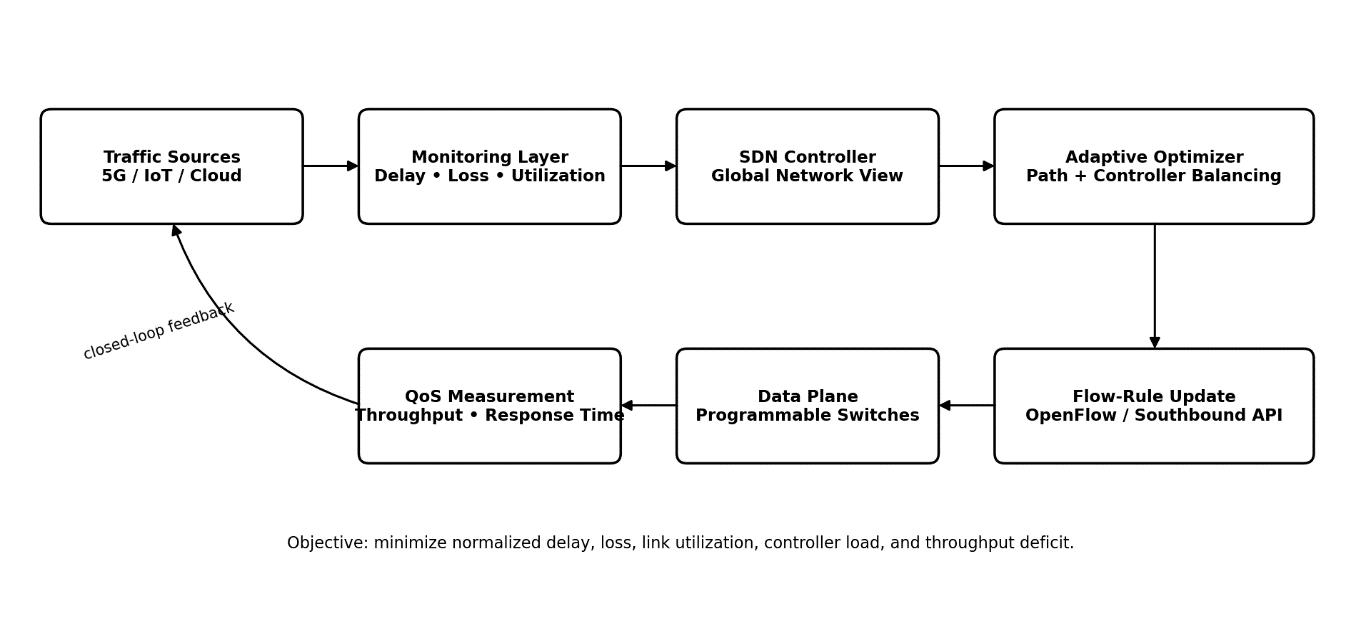
Software-Defined Networking (SDN) is a central enabling technology for next-generation communication systems because it separates network control from packet forwarding and allows traffic policies to be changed through software. However, the same programmability that makes SDN attractive also introduces performance problems involving controller saturation, flow-setup delay, uneven link utilization, inconsistent network state, and quality-of-service degradation under bursty traffic. This methodology paper proposes a closed-loop performance optimization framework that combines real-time monitoring, QoS-aware multipath routing, controller-load awareness, and adaptive flow-rule installation. The framework minimizes a multi-objective cost function constructed from normalized end-to-end delay, packet loss, link utilization, controller response time, and throughput deficit. A topology-based simulation model is used to compare a reactive shortest-path SDN baseline, a static QoS-aware policy, and the proposed adaptive optimizer under variable traffic representative of cloud, IoT, multimedia, and 5G-oriented services. The methodology emphasizes repeatability through fixed topology parameters, identical traffic demand sets, multiple randomized runs, and confidence-oriented aggregation of performance metrics. Model-based results show that the adaptive approach improves throughput while substantially reducing delay, packet loss, maximum link utilization, and controller response time relative to reactive shortest-path control. The study therefore provides a practical evaluation procedure for researchers investigating scalable SDN traffic engineering before full Mininet, OpenFlow, or physical testbed deployment.