Design and Implementation of an IoT-Based Smart Healthcare Monitoring System
Keywords:
Abstract
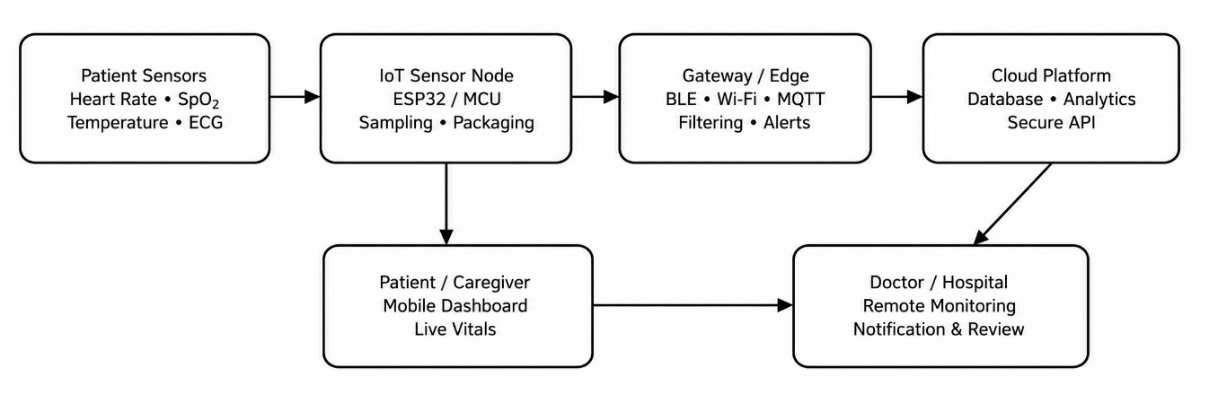
Internet of Things (IoT) technologies enable continuous healthcare monitoring by integrating wearable or bedside sensors, embedded processing, wireless communication, gateways and cloud applications. This methodology paper proposes the design and implementation of an IoT-based smart healthcare monitoring system for remote observation of physiological parameters such as heart rate, peripheral oxygen saturation (SpO₂), body temperature and electrocardiogram (ECG). The proposed architecture uses low-power sensor nodes connected to a microcontroller, a wireless gateway for data aggregation and local alert generation, and a cloud platform for secure storage, visualization and remote clinical access. IoT research has established the importance of distributed sensing and Internet-connected objects, while healthcare-specific studies show that IoT can integrate body sensors, wireless networks and medical applications. Wearable sensor studies further emphasize continuous monitoring, energy efficiency and communication reliability. Fog and edge architectures can improve responsiveness by processing urgent events near the patient rather than depending entirely on remote cloud connectivity. The proposed methodology evaluates sensor accuracy, packet-delivery ratio, end-to-end latency, alert delay, data availability, wireless range and power consumption. A prototype may use an ESP32-class microcontroller, pulse-oximetry and temperature sensors, an optional ECG module, MQTT/HTTP communication and a web/mobile dashboard. Because no primary patient dataset or hardware logs were supplied, the Results section contains illustrative expected results rather than fabricated measurements. The proposed design is an engineering research prototype and is not intended to replace certified medical equipment or clinical diagnosis.