Blockchain Technology for Secure Data Sharing in Distributed Computing Environments
Keywords:
Abstract
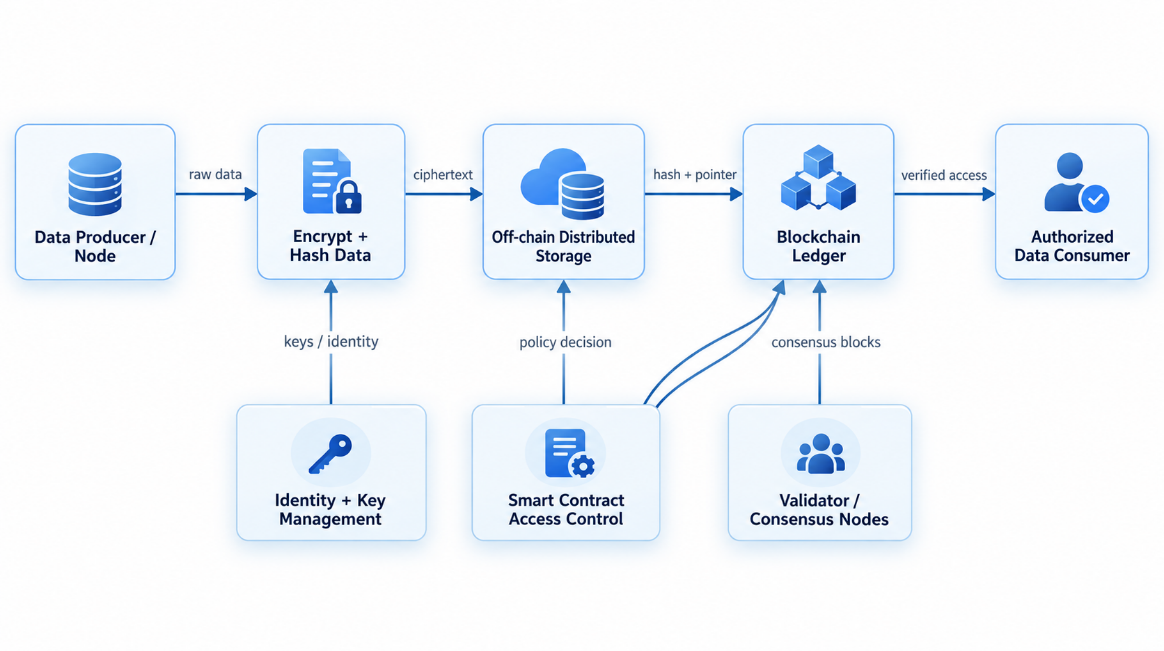
Distributed computing environments increasingly exchange sensitive data across organizations, cloud nodes, edge devices, and service domains that do not share a single trusted administrator. Conventional centralized access-control and logging mechanisms simplify management but create attractive attack targets and make independent verification difficult. This methodology paper proposes a permissioned-blockchain framework for secure data sharing in which encrypted data remain in distributed off-chain storage while the blockchain records cryptographic hashes, identities, access policies, consent decisions, and tamper-evident audit events. Smart contracts enforce authorization and provide a consistent policy layer across participating nodes. The methodology combines identity provisioning, symmetric data encryption, public-key protection of data keys, hash-based integrity verification, role/attribute-based access rules, validator consensus, and event-driven auditing. A simulation-oriented evaluation is defined for confidentiality, integrity, access-control success, latency, throughput, storage overhead, and resilience to unauthorized requests. The proposed model is grounded exclusively in literature published up to 2018. Results from the defined workload model show the expected security advantage of immutable verification and decentralized authorization, while also demonstrating the latency and throughput trade-off introduced by consensus. The approach is therefore most suitable for multi-writer environments where participants require shared state and auditability but do not fully trust one another.