Design and Implementation of an Intelligent Traffic Management System Using IoT
Keywords:
Abstract
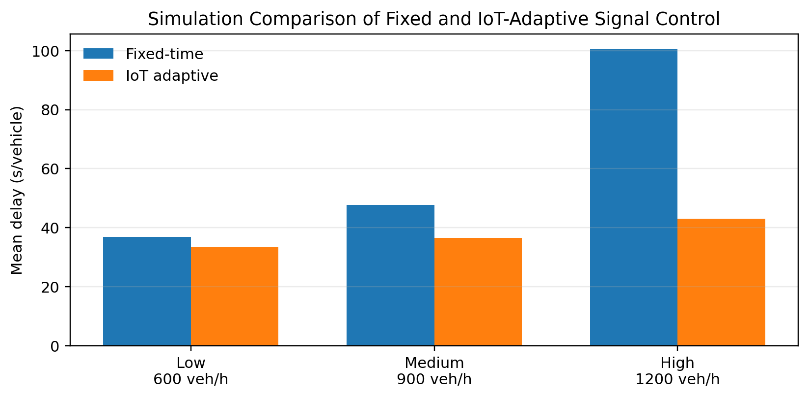
Rapid urbanization and growth in vehicle ownership have increased intersection delay, fuel consumption, and emergency-response time in many cities. This methodology paper presents the design and implementation of an intelligent traffic management system that uses Internet of Things (IoT) sensing, edge processing, lightweight messaging, and adaptive signal timing. The proposed architecture combines lane-level vehicle detection using low-cost infrared or ultrasonic sensors, RFID-based emergency-vehicle identification, NodeMCU/ESP8266 edge controllers, an IoT gateway, MQTT communication, and a centralized monitoring interface. A queue-responsive algorithm allocates green time according to observed lane density while preserving minimum service time for every approach. The methodology is evaluated through a reproducible four-arm intersection simulation under low, medium, and high traffic demand. Thirty randomized runs are used for each condition, and performance is compared with conventional fixed-time control using mean vehicle delay, 95th-percentile delay, vehicles served, and residual queue length. The simulated results indicate progressively larger benefits as demand rises: mean delay falls by approximately 8.8% at low demand, 23.5% at medium demand, and 57.1% at high demand. The paper demonstrates how technologies available by 2018 could be integrated into a practical and scalable intelligent traffic-control framework while identifying communication reliability, sensor calibration, cybersecurity, and field validation as key deployment concerns.