An Efficient Edge Computing Architecture for Smart Industrial Automation Applications
DOI:
https://doi.org/10.65521/ijacect.v6i1.4155Keywords:
Abstract
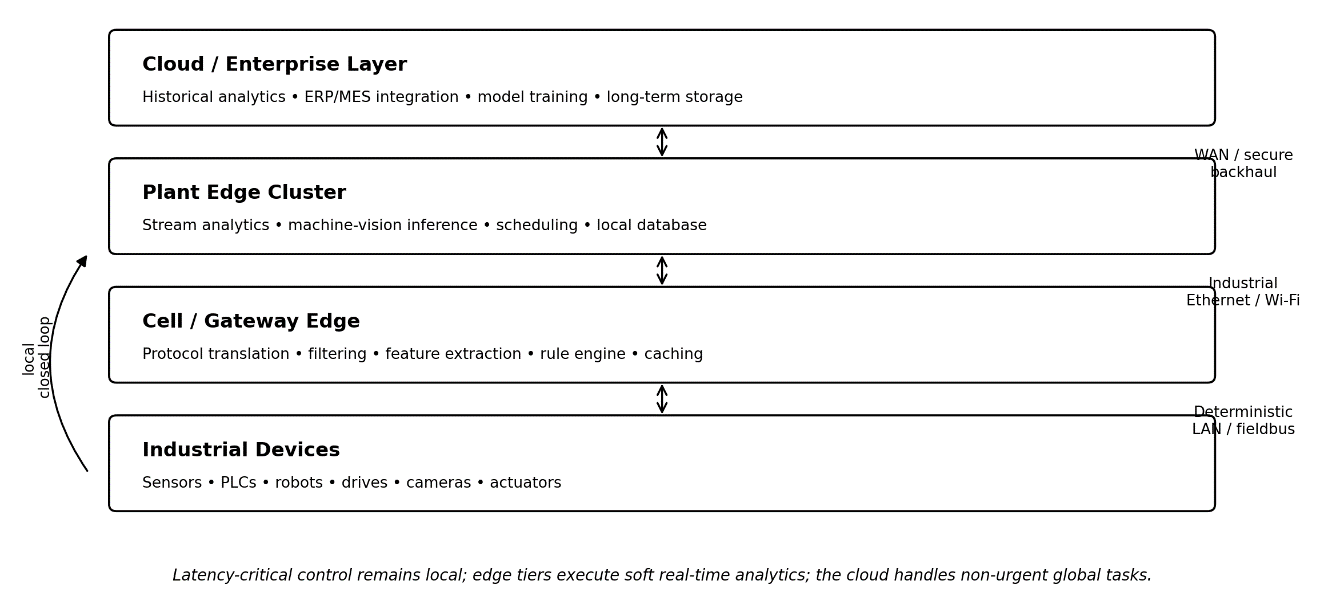
Smart industrial automation requires timely processing of sensor, machine, and production data while preserving the deterministic behavior of local control loops. Centralized cloud computing offers elastic resources but can introduce wide-area-network delay, bandwidth consumption, and dependence on remote connectivity. This paper proposes a four-tier edge computing architecture that separates hard real-time control, cell-level preprocessing, plant-level analytics, and enterprise/cloud functions. The methodology combines literature synthesis with a reproducible simulation-based evaluation of three processing strategies: cloud-only, gateway-plus-cloud, and the proposed multi-tier edge model. Tasks are classified by deadline, data volume, and computational demand, then placed at the nearest tier capable of meeting the required service level. A policy engine uses latency budgets, resource availability, and link condition to decide local execution or controlled cloud fallback. In a 5,000-job synthetic industrial workload, the proposed architecture reduced mean response time from 114.4 ms for cloud-only processing to 21.7 ms, increased deadline success from 14.1% to 95.2%, and reduced average WAN traffic from 89.0 KB to 2.7 KB per job. The results indicate that tier-aware placement can improve responsiveness and network efficiency while retaining cloud resources for non-urgent global optimization and historical analysis.