Performance Evaluation of LTE Networks for High-Speed Mobile Communication Applications
Keywords:
Abstract
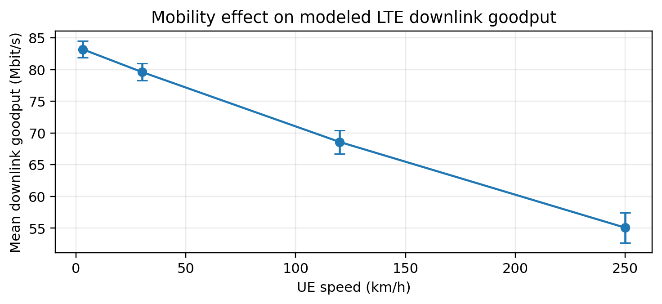
Long Term Evolution (LTE) was designed to provide high data rates, flexible spectrum use, low packet latency, and robust mobility for broadband mobile services. The practical value of these capabilities depends on how efficiently the radio link and mobility procedures operate when user equipment moves from pedestrian to high-speed conditions. This methodology paper develops a controlled framework for evaluating LTE performance for high-speed mobile communication applications. The study combines an LTE-oriented radio model, a mobility and handover model, and repeated Monte Carlo trials to quantify downlink and uplink goodput, packet delay, packet loss, handover interruption time, and mobility-related service degradation. Four speed conditions—3, 30, 120, and 250 km/h—are examined under a 20 MHz FDD LTE configuration with proportional-fair scheduling and 2×2 MIMO assumptions. The method is grounded in LTE performance and simulation literature published no later than 2016. Representative analytical-simulation results show that LTE retains useful broadband capacity at high mobility, while increasing speed produces a progressive reduction in goodput and an increase in delay, packet loss, and handover frequency. The framework is intended as a reproducible methodology for comparative LTE studies and clearly separates illustrative model-based outcomes from field measurements or full protocol-stack simulation.